Skip to content

Battle of the Bulge Tour: The Ardennes, Winter 1944

4.9 - 4 reviews

Length of Tour:
9 days | 8 nights
Brussels, Belgium, Germany, Luxembourg

On our Battle of the Bulge Tour, you will spend nine days crossing Belgium, Germany and Luxembourg to walk the ground of the largest land battle the United States fought in the Second World War, following the fight in the order it happened: the northern shoulder where the German main effort was stopped, the road Kampfgruppe Peiper took toward the Meuse, the Schnee Eifel where two American regiments surrendered, the Luxembourg ridge the 28th Division died holding, the perimeter at Bastogne, and the high-water mark four miles short of the river.

On December 16, 1944, three German armies came out of the Ardennes fog against a stretch of front the American command had left thinly held on purpose. The sector was a rest area, a place to season green divisions and refit exhausted ones, and the men holding it had been told that nothing would happen there. What followed ran six weeks in bitter cold, deep snow and icy water, and by the end it had cost the United States more casualties than any other 1 battle of the war. Roughly 600,000 Americans fought in the Ardennes. About 19,000 of them did not come home.

As Stephen Ambrose wrote of the Ardennes in Citizen Soldiers, many of the men on those thinly held lines were replacements only just out of training, untested and poorly equipped, sent forward with instructions on how to avoid trench foot and told to kill Germans. Some of them broke. Some of them held ground no one expected them to hold, and in doing so wrecked a German timetable that depended entirely on speed. Ambrose interviewed the men who came home, and the material became Citizen Soldiers and Band of Brothers. This tour is built on that primary research. You will travel from Brussels into the Ardennes and follow both sides of the fight across three countries, from the dragon’s teeth of the Westwall to the knocked-out Panther at Celles. You will stand at the Baugnez crossroads, where eighty-four American prisoners were machine-gunned in a field, and in the pasture at Wereth, where eleven Black artillerymen were tortured and killed and then left out of the official record for seventy years. You will walk into the pines at Bois Jacques, where the foxholes Easy Company dug are still in the ground, and end among the graves at Hamm, where General George S. Patton Jr. rests among his men.

We run this tour in December, in the month the battle was fought.

Soldiers at the Battle of the Bulge

Tour Video


Highlights

The Twin Villages, Krinkelt and Rocherath

Walk the northern shoulder where the 2nd and 99th Infantry Divisions stopped the German main effort in its tracks and never got the credit Bastogne did

In the Path of Kampfgruppe Peiper

Follow the exact route of the SS armored spearhead from Lanzerath through Honsfeld and Büllingen to Baugnez, Ligneuville, Stavelot, Trois-Ponts and La Gleize

Baugnez Crossroads

Stand at the site of the Malmedy massacre, where Peiper’s men murdered eighty-four American prisoners on December 17, 1944

The December 44 Museum, La Gleize

See Peiper’s abandoned King Tiger tank in the village square where his men left it and walked out on foot

The Wereth 11

Visit a cow pasture in the Ardennes and the only memorial in Europe dedicated to Black American servicemen of the Second World War

St. Vith and the Schnee Eifel

Cross the ground where two regiments of the 106th Infantry Division were encircled and surrendered, the largest mass surrender of American troops in the European theater

Clervaux and the Bloody Bucket

See the Luxembourg ground the 28th Infantry Division held to its own destruction, buying the days that let the 101st Airborne reach Bastogne first

The NUTS! Cellar, Bastogne

Stand in the cellar of the Bastogne War Rooms where General McAuliffe answered the German surrender demand with a single word The Bois Jacques Foxholes: Walk the treeline outside Foy where Easy Company, 506th PIR, dug in through the siege, the ground Ambrose wrote and the miniseries filmed

Assenois

Follow the corridor where Lieutenant Colonel Creighton Abrams’ tanks of the 4th Armored Division punched through and broke the siege the day after Christmas

The Luxembourg American Cemetery at Hamm

Pay your respects among 5,076 American graves, including that of General George S. Patton Jr. Celles: See the knocked-out Panther marking the farthest point the German advance reached, four miles short of the Meuse and out of fuel

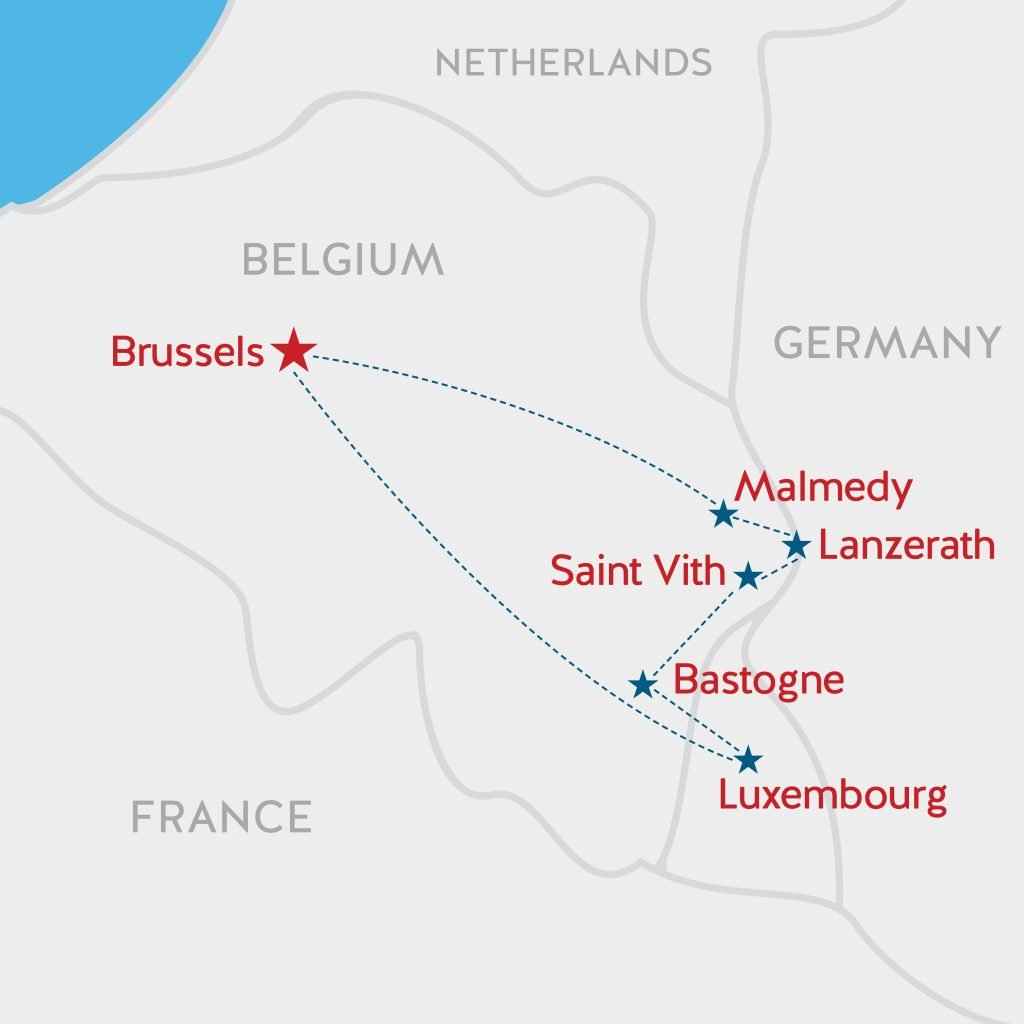
Map of the Battle of the Bulge

Itinerary

Guests traveling from outside Europe fly overnight to Brussels Airport (BRU) and make their way to the tour hotel. The evening is your own to recover from the flight before the tour moves east in the morning.

You will meet your group in Brussels and travel east into the Ardennes, stopping at the tank barriers at Hollerath, the dragon’s teeth of the Westwall, and the Losheimergraben crossroads, where the German attack came through on the morning of December 16, 1944. After the church steeple at Hünningen you will walk the twin villages of Krinkelt and Rocherath and the crossroads at Lausdell, where the 2nd and 99th Infantry Divisions fought the German main effort to a standstill and denied it the road net the whole plan had been built around. It is the most consequential ground on the tour and the least visited. The evening brings a Welcome Dinner and your historian’s first lecture on the Ardennes campaign.

Today follows Kampfgruppe Peiper, the SS armored spearhead ordered to drive for the Meuse. From the railway bridge at Scheid east of Losheim you continue to Lanzerath, where eighteen men of an intelligence and reconnaissance platoon under Lieutenant Lyle Bouck, joined by a four-man artillery observation team, held up a German parachute battalion for most of December 16 and cost the SS column behind them some twenty hours it could not spare. Following Peiper’s route through Honsfeld and Büllingen, you will break for lunch in Malmedy before reaching the Baugnez crossroads, site of the Malmedy massacre, and Ligneuville, where the killing continued. The afternoon runs through Stavelot and its halftrack memorial to the railway tunnel at Trois-Ponts and the December 44 Museum at La Gleize, where Peiper’s abandoned King Tiger tank still sits, closing near Habiémont, where American engineers blew the bridge in his face with his lead tanks in sight of it.

The 106th Infantry Division, the Golden Lions, reached the front on December 11, 1944 and was holding twenty-one miles of it when the attack came five days later. You will begin at the 106th Infantry Division Memorial and the 168th Engineer Battalion Monument at St. Vith, then visit the Captain Eric Fisher Wood Memorial near Meyerode and the Wereth 11 memorial, which stands in a pasture where eleven men of the segregated 333rd Field Artillery Battalion were betrayed, tortured and shot on December 17, 1944, and is the only memorial in Europe dedicated to Black American servicemen of the Second World War. After lunch on your own in St. Vith, the afternoon crosses the ground where the 422nd and 423rd Infantry Regiments were encircled and surrendered on December 19, running from Andler toward Schönberg and past Hill 204 to the church at Bleialf, the Schwarzer Mann heights and the ridge road toward Roth and Auw, where the German columns came across.

The 28th Infantry Division wore a red keystone the Germans called the Bloody Bucket, and it was strung out along a Luxembourg ridge road, resting and rebuilding after the Hürtgen Forest, when the attack came. You will begin at Clervaux, where the division’s 110th Infantry made its stand, with the château in the valley and the American memorial in the town, then follow the fighting to the bridge at Dasburg, the water tower at Hosingen, where a rifle company and an engineer platoon held a village against a division for two days, the Café Schinker crossroads, and Wiltz, where the division band fought as infantry and is remembered by the Bazooka Boogie memorial. The day ends on the approaches to Bastogne at Longvilly, St. Michael’s Grotto, Mageret, Neffe and Marvie, where roadblock fighting bought the hours the 101st Airborne needed to get into the town first.

Seven roads meet at Bastogne, which is why the 101st Airborne was trucked up from Reims without winter gear and why the town was surrounded by December 21. Your day begins at the Bastogne War Rooms, where you will stand in the NUTS! Cellar in which General McAuliffe answered the German surrender demand on December 22, 1944, and continues at the Bastogne War Museum and the Mardasson Memorial, where the whole map is laid out at once. After lunch on your own in Bastogne you will work around the sixteen-mile perimeter: Noville, where a scratch force of armor and paratroopers held long enough to matter; the pines at Bois Jacques, where the foxholes Easy Company dug are still visible in the ground; a view across the fields to the Kessler Farm; the 326th Airborne Medical Company memorial at the Barrière Hinck crossroads, where the division’s field hospital was overrun on December 19; and Hemroulle and Champs, where the glider infantry fought German tanks at close range on Christmas morning.

You will follow the route of the relief from the south, through Clochimont and the bunker at Assenois, where Lieutenant Colonel Creighton Abrams’ tanks of the 4th Armored Division punched a corridor through to the town on December 26, 1944 and broke the siege. Crossing into Luxembourg, you will spend the middle of the day at the National Museum of Military History in Diekirch, whose life-size dioramas of the Ardennes fighting are among the finest anywhere, with lunch on your own in the town. The day closes at the Luxembourg American Cemetery at Hamm, where 5,076 Americans are buried and where General George S. Patton Jr. lies among the men he commanded, facing them.

Turning west toward Brussels, you will stop at La Roche-en-Ardenne, a town largely destroyed in the fighting and the shelling that followed, to see the Battle of the Bulge Memorial and the M10 Achilles tank destroyer. Your last stop on the battlefield is Celles, near Foy-Notre-Dame, where a knocked-out Panther tank marks the farthest westward point the German advance ever reached: the lead elements of the 2nd Panzer Division stopped here on Christmas Day, out of fuel and caught in the open, four miles short of the river they had set out to cross. The evening brings a Farewell Dinner and a concluding discussion at your airport hotel in Brussels.

The tour ends with a morning transfer to Brussels Airport (BRU) to catch flights home.

Dates & Prices

Dates
Double Occupancy
Single Occupancy

Tour Includes

  • Professional historian traveling with you throughout the tour, lecturing and answering questions
  • Tour manager to handle guest needs and on-the-ground logistics
  • Educational road book of maps and historical information
  • 3 or 4-star hotel accommodations
  • Rooms with private bath or shower
  • Hotel taxes and service charges
  • Touring by private first class, air-conditioned motor coach
  • Breakfast daily, most dinners
  • All entrance fees to museums and attractions

Flights

Flights are not included in the cost of the tour.

Flights

Flights are not included in the cost of the tour.

Activity Level

As with all of our tours, we prefer to spend our time on the ground where the history happened. There will be some museum stops, but please be prepared to walk on uneven terrain at battlefield sites, including forest tracks, farm ground and the foxhole lines in the woods. There is a fair amount of walking, and several days cover long distances by motor coach.

If you use a wheelchair, please read our Wheelchair Policy.

Customize this Tour

If you would like to customize this itinerary for your alumni travel association, educational organization, high school, family or other private group, please see our private tours page.

Guest Reviews

4 reviews for 'Battle of the Bulge Tour: The Ardennes, Winter 1944'

5 Star100%
4 Star0%
3 Star0%
2 Star0%
1 Star0%

July 18, 2022

Outstanding trip!

George and Cheryl Holt says:
5.0

We were part of a small, post Covid tour and it was absolutely fabulous! Our leader was Chris Anderson who has been with many of the veterans previously on his tour. His personal first hand knowledge of events made this tour very special indeed. A highlight for us was being at Dick Winter’s foxhole in the Ardennes.
No matter how much knowledge (or lack thereof) you have beforehand, this tour provides much more!
A truly authentic experience in December awaits the travelers!


August 19, 2020

Battle of the Bulge and other WW2 Tours

Mike Rueb says:
5.0

You could not ask for a truer patriot then Len Fullenkamp to lead you through any of the Ambrose WW2 tours. Len is the real thing and I can guarantee that he will lead you to the place you are looking for in your journey in like.


February 27, 2020

Battle of the Bulge Tour

Barry Eggleston says:
5.0

Ambrose Historical Tours made this trip of a lifetime an experience that I will treasure greatly. This was a First-Class operation with an EXCELLENT driver, tour manager and tour historian. Each day’s itinerary was exciting, memorable and educational…so much so that I didn’t sleep much each night as I was still processing what I had seen that day, while looking forward to what I was going to see the next day. Simply cannot thank y’all and our tour group enough for making the Battle of the Bulge Tour my greatest adventure.


December 14, 2019

U. S. Army cemetery Ardennes

paul cassavechia says:
4.5

The candlelight ceremony at the Luxembourg U.S. Army burial site is very, very special.

Write your review

Your name will be published with your review
Your email address will not be published.
We will keep your review for moderation to verify that you have been a traveler for this trip.

Stay Connected

Sign up for our newsletter, visit us on Facebook, Instagram or YouTube.

Sign Up Now