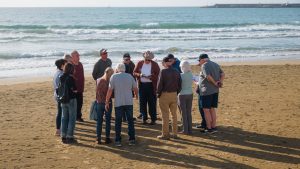
This is the second trip that my wife and I have taken with Stephen Ambrose Historical Tours. We had the pleasure of having Chris Anderson as our Historian and George Luz, Jr. as our Tour Manager for both trips. They are the best in the tour business! I never knew much about Polish history before this trip. Chris did an incredible job of taking us back into time and showing us how Poland’s history was closely tied to World War II and why Hitler had a deep hatred toward Poland. The trip was like pieces of a puzzle that Chris put together for us throughout the tour. Today’s Poland is amazing and beautiful with wonderful people – I admire them greatly. Over the centuries Poland was beat down time and time again, but they have come back even stronger. Amazing country! We loved this trip! A side note: My wife had a stress fracture in her leg for the entire trip and our drivers (Klaas and Lucas) were so gracious and caring – they always made sure the wheelchair was available for us to use. Both men were wonderful – and great drivers too!
At 4:45 AM on September 1, 1939, the German battleship Schleswig-Holstein, anchored in Gdansk harbor on what its captain had claimed was a courtesy visit, opened fire on the Polish military depot at Westerplatte. The Polish garrison of 182 men was supposed to hold for 12 hours. They held for seven days. By the time they surrendered, World War II had been underway for a week. By the time it ended, the Polish nation had lost six million of its citizens; 17% of its prewar population, the highest national death rate of the war. The Polish road from that morning at Westerplatte to the German surrender at Karlshorst on the night of May 8, 1945, is the road this tour walks.
In American memory, WWII is mostly an American story. In Polish memory, it is something else. Poland was invaded twice in 1939, by Germany on September 1 and by the Soviet Union on September 17. Its government-in-exile fielded the third-largest Allied army in Europe by 1945, with Polish soldiers fighting in the Battle of Britain, at Monte Cassino, in Normandy, and at Arnhem.
It was the country in whose occupied territory the Germans built the death camps. Its underground Home Army, 400,000 strong, was the largest resistance organization in occupied Europe. And it was the country handed at war’s end to a Soviet sphere it had not chosen, in which it remained for 44 years. This tour walks the country that paid for the war.
This tour is 14 days long, from Gdansk on the Baltic to Berlin in the heart of Germany, with Warsaw, the Masurian forests, Kraków, Auschwitz, and the Lower Silesian forests in between. It runs from where the war began to where it ended.
Along the way, you will:
- Walk Westerplatte, the small Polish military depot in Gdansk harbor, where on September 1, 1939, the German battleship Schleswig-Holstein opened the war with point-blank fire. The 182 Polish defenders, supposed to hold for 12 hours, held for seven days against air, sea, and infantry assault. The concrete walls of Guardhouse No. 1 are still pocked with the gunfire.
- Visit the Polish Post Office of Gdansk, where on September 1, 1939, about 50 postal workers and Polish boy scouts held the building against German SS and police troops for fifteen hours. After surrender, 38 of them were summarily executed. They had not been combatants. Most had been civil servants the day before.
- Visit the Solidarity Monument and the European Solidarity Centre at the Gdansk Shipyard, where in 1980 an electrician named Lech Wałęsa led a strike that began the movement that ultimately ended communist rule across Eastern Europe. Gdansk has watched two epoch-changing struggles in a single century, both of them fought from the same harbor.
- Walk through the ruins of the Wolfsschanze, Hitler’s heavily fortified Eastern Front headquarters in the pine forests of the Masurian Lake District, where he spent more than 800 days of the war. It is also the bunker where on July 20, 1944, Col. Claus von Stauffenberg planted the briefcase bomb that was meant to kill Hitler and almost did.
- Walk the streets of the former Warsaw Ghetto, where between November 1940 and May 1943 the Germans confined as many as 460,000 Jews behind a 10-foot wall. Visit the Umschlagplatz monument, marking the railhead from which roughly 300,000 of them were deported to death camps. Then visit the Mila 18 memorial, at the bunker where on May 8, 1943, the leadership of the ghetto uprising killed themselves rather than be taken alive.
- Walk Warsaw’s Old Town — every brick of which was destroyed by the Germans in retaliation for the 1944 Warsaw Uprising and rebuilt after the war from prewar architectural drawings and Bellotto’s 18th-century paintings. Stop at the Tomb of the Unknown Soldier, the surviving fragment of the Saxon Palace, where Polish soldiers from every war the country has fought are honored.
- Tour the Warsaw Rising Museum, dedicated to the 63-day uprising of August 1944, when the Polish Home Army of roughly 40,000 fighters seized the city in expectation of Soviet support that never came. The Red Army stopped on the east bank of the Vistula and watched. By the end, 16,000 Home Army fighters and 200,000 civilians were dead, and the Germans had razed what was left.
- Walk up Wawel Hill in Kraków to the Royal Castle, the ancient seat of Polish kings, and the cathedral where most of them are buried. Among the tombs is that of Tadeusz Kościuszko, hero of the American Revolution and the man Thomas Jefferson called “as pure a son of liberty as I have ever known.” Stand in the rooms where Polish history was made for a thousand years.
- Walk Kazimierz, the historic Jewish quarter of Kraków, home before the war to about 70,000 Jews, almost none of whom survived. Visit the Galicia Jewish Museum and the historic synagogues of the district. Cross the Vistula to the former site of the Kraków Ghetto, and tour the Oskar Schindler Enamel Factory (now a museum of wartime-occupied Kraków), where some 1,200 Jewish workers survived the war.
- Walk through the gates at Auschwitz I and Auschwitz II-Birkenau, the largest of the German concentration and extermination camps, where between 1940 and 1945 approximately 1.1 million people were murdered — about 90% of them Jews from across occupied Europe. Auschwitz I has been preserved as a museum since 1947. Birkenau, where the gas chambers operated, has been preserved largely as the SS left it.
- Visit Stalag Luft III at Żagań, the German POW camp for captured Allied airmen made famous by the 1963 film The Great Escape, where on the night of March 24, 1944, 76 prisoners crawled through a 100-meter tunnel and escaped into the woods. Three made it home. Fifty were summarily executed by the Gestapo on Hitler’s orders. Visit the museum and the monument to the murdered fifty.
- Stand on the Seelow Heights east of Berlin, where on April 16, 1945, Marshal Georgi Zhukov’s 1st Belorussian Front, the army that had fought west across Poland alongside the 1st Polish Army, opened the final Soviet offensive of the war with a bombardment from nearly 9,000 artillery pieces. The four-day battle that followed cost the Red Army roughly 30,000 killed and wounded. Berlin fell two weeks later.
- End in Berlin: at the Brandenburg Gate, where Soviet soldiers raised flags in 1945; at the Topography of Terror, on the site of the SS and Gestapo headquarters; and at Museum Berlin-Karlshorst, where late on the night of May 8, 1945, Field Marshal Wilhelm Keitel signed the unconditional surrender that ended the war the Polish garrison at Westerplatte had begun resisting almost six years before.
Poland was the first country to be invaded, the country with the highest civilian death rate of the war, the country whose underground was the largest in occupied Europe, and the country in whose forests the Reich placed the death camps. It was also the country that fought beside the Western Allies on every front, in the air over Britain, on the slopes at Cassino, in the hedgerows at Falaise, and was handed at war’s end to a Soviet sphere it had not chosen. The road from Westerplatte to Karlshorst is the Polish century. This tour walks it.
By the end of these 14 days, you will know what “the war began in Poland” actually means, not only the dawn of September 1, 1939, but the five years and eight months of occupation that followed.
You will have stood at Auschwitz. You will have read the names at the Mila 18 memorial. You will have walked the streets of Warsaw’s Old Town that were rebuilt one brick at a time. You will know who the Home Army was, what they fought for, and what the Red Army did not do for them across the Vistula in the autumn of 1944. And the Polish century will no longer be a footnote in your reading of WWII.
Explore more of our upcoming historical tours and travel experiences to find your next adventure.
Highlights
Gdansk
Begin in Gdansk at Westerplatte where the Polish garrison withstood German naval, artillery and infantry assaults for seven days in the war’s first action
Hitler’s Wolf’s Lair
Walk through the eerie remains of Hitler’s Wolf’s Lair hidden in the pine forests of NE Poland, where he masterminded his eastern front operations and survived an assassination attempt
Warsaw
Tour Old Town Warsaw, completely rebuilt after the city was destroyed, and the Warsaw Rising museum, tribute to the courageous 1944 battle that lasted 63 days
Krakow
Visit 1,000-year-old Krakow, the Royal Castle and Oskar Schindler’s Enamel Factory and Museum before entering through the “Arbeit Macht Frei” gates of Auschwitz, the international symbol of the Holocaust
Stalag Luft III
Visit Stalag Luft III where The Great Escape took place, seeing the barracks and remnants of tunnels Tom, Dick and Harry dug by the Allied airmen
Berlin
Stand where the final surrender took place at Karlshorst, and see the Reichstag and the chilling Topography of Terror Museum
Itinerary
Guests will meet at the designated tour hotel in Gdansk, where the group will gather for a Welcome Reception followed by dinner. Your historian will provide a briefing and overview of the tour and the key sites you will visit, with introductions all around.
The world has focused on the Polish city of Gdansk twice during the last century. The first shots of WWII rang out here in 1939, and in 1980 the Solidarity movement led by electrician Lech Walesa began its confrontation with the Communist government in the shipyards.
On 1 September 1939 the Germans attacked the Westerplatte peninsula in the port of Gdansk. The Polish garrison of 182 soldiers withstood German naval, artillery and infantry assaults for seven days in what was the first military action of WWII. Here, you will view the massive monument to the Heroes of Westerplatte and visit the small museum nearby in what was Guardhouse No 1. The concrete walls are still pocked by enemy gunfire. The Wisloujscie Fortress, originally constructed in the Middle Ages, stands here as a sentinel for the harbor. Over the years architects upgraded the fortifications to enable resistance to modern weaponry. You will visit the Polish Post Office where armed postal workers and boys scouts held off German militia and armored attacks before surrendering. They then faced summary execution.
From here you will go to the Gdansk Shipyard and Solidarity Monument to visit the site were the movement to topple communism began. The nearby Museum documents the beginning of the movement, the years of Martial Law in Poland, and the ultimate victory over a failing system.
The Old Town of Gdansk, completely rebuilt after WWII, features a marketplace, ornamentally decorated town houses and numerous monuments along the Royal Way. Perhaps the most famous is the Neptune Fountain, the symbol of the city. You will see this fountain and also tour the Museum of Gdansk in the Main Town Hall. Its ornate rooms and collections offer insight into the history of the city and are an ideal starting point for the Old Town.
After lunch you will depart for Ketrzyn, the site of Hitler’s Wolfs Lair. Built in the pine forests of the Masurian Lake District, the headquarters had 50 bunkers, a complete power system, and an airstrip and railroad terminus. Once camouflaged and surrounded by mine fields and razor wire, the ruins offer a glimpse into the sinister nerve center of Hitler’s eastern operations. The Wolfsschanze was the setting for the failed plot to assassinate Hitler in July 1944.
After an early breakfast you will depart for Warsaw. En route, you will stop at Grunwald, the scene of Europe’s largest medieval battle. In 1410, the Allied forces of the Kingdom of Poland and the Grand Duchy of Lithuania decisively defeated the Teutonic Knights. This victory drastically changed the balance of power in central Europe.
This area was also the location for the Battle of Tannenberg in 1914 between Germany and Russia. It was one of the key battles of WWI, and it put the Romanov Empire on the slippery slope to oblivion.
You will arrive in Warsaw in the early evening. Tonight, you are free to relax at the hotel or explore the Old Town.
This morning, you will visit the Polish Army Museum. An array of weaponry, uniforms, paintings and historical collections tell the story of Polish armed forces from the Middle Ages to WWII. Permanent exhibits include The Defense in 1939, and The Polish Army in the East 1943-45. Afterwards you will go to the site of the infamous Jewish Ghetto and the Path of Remembrance, which includes the Umschlagplatz where the Nazis loaded deportees onto cattle cars for resettlement in the east. You will continue to the Jewish Historical Institute.
You will finish the day at the Tomb of the Unknown Soldier. You will visit the beautiful Old Town (Stare Miasto) and the main square. The people of Warsaw used architectural drawings and artists’ renderings to completely rebuild and restore this area after the devastation of WWII and it is beautiful.
You will also tour the Royal Castle at Plac Zamkowy (Castle Square). It was once the royal residence of Polish monarchs and is now a state museum and a UNESCO World Heritage Site. Here King Zygmunt III took up residence in 1611 and made Warsaw the capital of the Polish Commonwealth. His statue, with a cross in one hand and a sword in the other, stands in the center of the square.
In the morning you will go to Modlin Fortress on the outskirts of the city. Napoleon’s engineers constructed the fortress in the early 1800’s. Years later it became the scene of the last of Polish forces to fall to the Germans in 1939. The surrounding structures and museum afford a view into a little known chapter of this period of WWII.
After lunch you will go to the Warsaw Rising Museum. Here you will see the exhibits that describe the history of Poland during the war. The actual Rising of the Polish Home Army against the Germans in 1944 is the main feature. The Home Army of some 40,000 soldiers and citizens battled the Nazis and their reinforcements fiercely for 63 days. They waited in vain for support from the Red Army, but the Soviets refused. In a rare tribute to their enemies, the Nazis granted the Polish combatants POW status.
We will board the train for Krakow immediately after breakfast. Upon arrival, you will walk up Wawel Hill to the Wawel Royal Castle. The Poles erected the first buildings here in the year 1000, including a stone cathedral. Redecoration in the Italian Renaissance style occurred in the early 16th century. Here also are the Royal Tombs, where most of Poland’s monarchs are buried, as well as a few national heroes. Perhaps most notable is Thaddeus Kosciusko, Polish patriot and hero of the American Revolution. Kosciuszko is considered the father of West Point and American artillery.
In the evening you will have time to enjoy and explore downtown Krakow.
Today, you will go to the Kazimierz district, the old Jewish neighborhood, which is home to the Galicia Jewish Museum and the Isaac Synagogue, the largest and one of the most beautiful synagogues in the city. Afterward you will cross the Vistula River to what was once the Jewish Ghetto.
After lunch, you will visit the Home Army Museum. Although the exhibits show Polish military history for the last 100 years, the emphasis is on the struggle and resistance against the Nazis in WWII. Polish pilots were vital in the Battle of Britain, so you will take in the Polish Aviation Museum with more than 100 aircraft at its airfield.
This morning you will depart for the international symbol of the Holocaust, genocide and terror: Auschwitz. You will see the Main Camp and Birkenau, where you will experience the eerie chills of the admonition “Arbeit Macht Frei” (Work Makes You Free) above the gates. You will be here until the afternoon, before departing for Wroclaw for the night.
After breakfast and a morning tour of the old town of Wroclaw (Breslau), you will leave for Zagan, where The Great Escape of book and film took place. Here at Stalag Luft III, 80 imprisoned airmen escaped through a 111-meter tunnel. Thus began a colossal manhunt throughout the entire territory of the Reich. Only three escapees were completely successful, while 50 of the 73 others were captured and executed. You will see the monument to the escape and visit the Museum of Allied Prisoners of War Martyrdom.
You will depart immediately after breakfast for Seelow Heights. As the massive three pronged Soviet advance converged upon Berlin, General Georgy Zhukov pitted his one million men and more than 3,000 tanks against the German defenses on the Oder River. You will see the Red Army command bunker and observation posts, German defense trenches and the first Soviet T-34 tank to cross the Oder. After stopping at the cemetery, you will proceed to Berlin.
This morning you will pass the Brandenburg Gate on the way to the nearby Reichstag. The Nazis paraded through the gates to celebrate their assumption of power in 1933. The famous fire that same year at the Reichstag enabled the Nazis to blame enemies of the state and embark on their official reign of terror. You can still see graffiti left by Red Army soldiers in 1945. You will move on to the Soviet Memorial and then a remnant of their post-war legacy, Checkpoint Charlie. This is the well-known Cold War crossing point between East and West Berlin.
Today, you will visit Karlshorst where the final surrender of Nazi Germany took place. The room where the documents were signed is still intact. You will then see the Topography of Terror, a museum which chronicles the history of Nazism, before ending the day at the Reichstag.
This evening, we will gather at our hotel for a farewell dinner.
There will be one morning transfer to Berlin Brandenburg Airport for your flight home.
Dates & Prices
Tour Includes
- Professional historian traveling with you throughout the tour, lecturing and answering questions
- Tour manager to handle guest needs and on-the-ground logistics
- Educational road book of maps and historical information
- 3 or 4-star hotel accommodations
- Rooms with private bath or shower
- Hotel taxes and service charges
- Touring by private first class, air-conditioned motor coach
- 14 breakfasts, most dinners, some lunches and a welcome reception
- All entrance fees to museums and attractions
Flights
Flights are not included in the cost of the tour.
Flights
Flights are not included in the cost of the tour.
Activity Level
Please be prepared for significant time walking over the course of each day – often outdoors and on cobblestone streets, gravel paths and inclines — as we explore historic sites and museums. Please note that there may be some sites that are not ADA accessible.
If you use a wheelchair, please read our Wheelchair Policy.
Recommended Reading
A Traveller’s History of Poland by John Radzilowski
Customize this Tour
If you would like to customize this itinerary for your alumni travel association, educational organization, high school, family or other private group, please see our private tours page.
Guest Reviews
Amazing Trip Back Into Time
WWII Poland and Germany Tour
This profoundly moving tour dramatically expanded my understanding of WWII in Europe, particularly the often over-looked (by Americans) heroism and resilience of the Polish people. Bookended by visits to the sites where the war began (in Gdansk) and ended (in Berlin), the tour included many of the most iconic locations of WWII. Highlights for me were: seeing the Polish Post Office building in Gdansk; walking through the ruins of Hitler’s bunker at the Wolf’s Lair; visiting the “Mila 18” memorial in Warsaw; contemplating the Holocaust at Auschwitz-Birkenau, and studying the large-scale battlefield where a million Russian soldiers broke through to Berlin. Other stops were more contemporary, such as the Gdansk shipyard and the Berlin Wall. Along the way, our tour leader Chris Anderson and several local guides did an outstanding job of describing exactly what we were seeing and placing it in historical context. Chris cares deeply about the history and meaning of the war, which helped to make this trip an unforgettable experience.
Fantastic trip w/ the Best Guide in the Business!
Just got back from the Poland portion of this trip (led by Chris Anderson) and it was an absolute great time. Between the nice hotels, nice bus, nice driver, excellent itinerary, but most of all, the best guide in the business in Chris Anderson, it was a top notch, unparalleled tour. Chris is not only knowledgeable but passionate about history and understands the sacredness of the locations that we visited, and this passion comes through in the way he explains things.
In addition to Chris, SAHT brings in local experts at Gdansk, Wolf’s Lair, Warsaw castle, and Krakow, among others. They are well versed in their areas of expertise and deliver stories and knowledge with an energy that conveys how important these areas are to them, and to history.
The hotel stay at the Hotel Zemek Ryn is an interesting one as a 15th century castle turned four star hotel is an interesting transformation. Even though it took me a little bit to feel comfortable, I hope this stays on the itinerary as it is one of the aspects that make this tour unique and special.
Overall, it is a great tour and well worth it. I also met some very nice and interesting people. Highly recommend!
Having visited most of the battlefields of Western Europe, this trip allowed me to round out my experience by visiting other battlefields of Eastern Europe.
Historical content seemed to flow well and really helped to understand the history of Poland and Germany….took time to talk to everyone in the group and include everyone in different discussions.
Mark was more than knowledgeable, presented details in context of where we were and what we were experiencing, with an excellent sense of humor. Kept things organized, moving and relevant.
If you can only take one trip take the Poland Tour. All of the guides were very knowledgeable about the places and things we saw. The hotels were a mixture of old world and new. The people of Poland are hard working and very friendly. The food was outstanding.