Skip to content

In Patton’s Footsteps

5.0 - 2 reviews

Length of Tour:
11 days | 10 nights
France, Luxembourg, Belgium, Germany

One general, one army, and the fastest advance in American military history, followed from the Normandy hedgerows to the German frontier.

George S. Patton believed in filling the unforgiving minute with sixty seconds’ worth of distance run, and he spent the summer of 1944 proving it. On the In Patton’s Footsteps Tour you follow Third Army from the Cotentin farm where it waited to become operational, through the breakout at Avranches, across France, into the Ardennes to relieve Bastogne, and on to the Rhine.

You will stand at the Pontaubault bridge his divisions poured across, on the hill at Mortain where the German counterstroke was stopped, above the Falaise Pocket where the German army in Normandy was destroyed, and in the Verdun room where he promised Eisenhower he could attack north in forty-eight hours. The tour ends where his war did: the corner outside Mannheim where a road accident cost him his life, and the cemetery at Hamm where he lies among his men.

Your Historian

Kevin Hymel leads this tour. A historian for the U.S. Army who has also served at the Combat Studies Institute at Fort Leavenworth, he is the author of Patton’s War: An American General’s Combat Leadership, Volumes 1 and 2, and Patton’s Photographs: War as He Saw It.

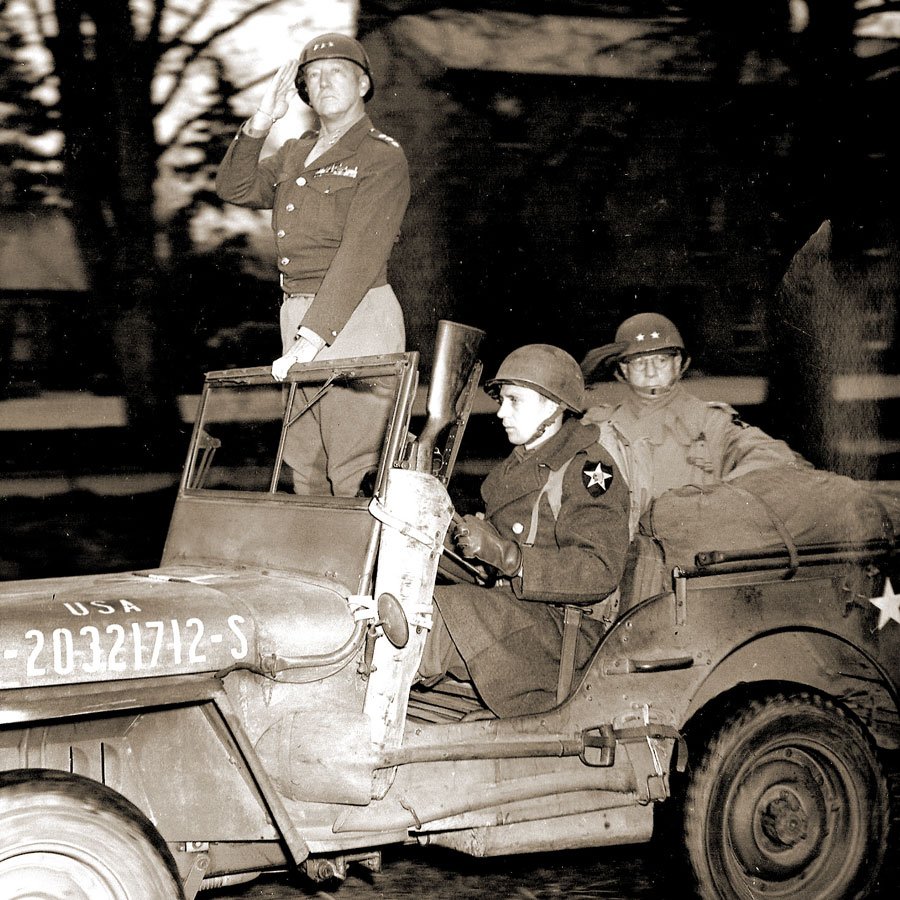
Wartime photo of Patton in a jeep

Highlights

Normandy and the Invasion Beaches

Omaha and Utah, Pointe du Hoc, Brécourt Manor, Sainte-Mère-Église and the Normandy American Cemetery, where taps is sounded at the flag lowering.

Camp Patton at Nehou

The Cotentin orchard where Patton waited out the weeks before Third Army became operational, hidden from the press and from the Germans.

Avranches and the Pontaubault Bridge

The hinge of the entire campaign, where Third Army funnelled seven divisions across a single bridge in seventy-two hours and broke into open country.

Mont-Saint-Michel

The medieval abbey rising from the tidal flats, toured with a local guide, and a rare hour of peace in a fighting itinerary.

Mortain and the Falaise Pocket

Hill 314, where a cut-off battalion held for six days against the German counterattack, and Mont-Ormel, looking down on the valley where an army was destroyed.

Reims and Verdun

The schoolhouse where Jodl signed the German surrender, and the barracks where Patton told Eisenhower he could be attacking toward Bastogne in forty-eight hours.

Patton’s First War

Pannes and Essey-et-Maizerais, where a 32-year-old Lieutenant Colonel led tanks into the Saint-Mihiel offensive and stood under shellfire beside Douglas MacArthur.

Metz and Fort Hackenberg

The fortress city that stopped Third Army cold in the autumn of 1944, and the largest surviving work of the Maginot Line, toured underground.

Bastogne

Bastogne Barracks and the 101st Airborne Museum in the town Patton relieved, having turned an army ninety degrees in winter to get there.

The Rhine and Mannheim

A lunch cruise through the Middle Rhine Valley, then the corner where Patton’s war ended, and his grave at the Luxembourg American Cemetery.

Stops on the Patton tour

Itinerary

You join the group at the designated Paris Charles de Gaulle Airport hotel for a Welcome Reception followed by dinner, and your historian’s first lecture.

You depart Paris for Normandy, heading towards Omaha Beach. Your historian covers the landings of the 1st and 29th Divisions in the bloodiest action of the day. The day closes at the Normandy American Cemetery above Colleville-sur-Mer for the flag lowering ceremony and taps.

The morning begins at Brécourt Manor, where Lieutenant Dick Winters and the men of Easy Company took the German battery firing on Utah Beach, followed by the Utah Beach Museum at Sainte-Marie-du-Mont. In the afternoon you visit Pointe du Hoc, where the Rangers scaled the cliffs and hunted down the relocated guns, then Sainte-Mère-Église, the first French town liberated, and La Fière, where the 82nd Airborne fought three days for the Merderet causeway.

You begin at Camp Patton in Nehou, the Cotentin orchard where Patton spent July 1944 waiting for Third Army to become operational while the press was told nothing of his whereabouts. Driving south through Coutances, you reach Avranches, where Third Army took command of the breakout, and the Pontaubault bridge, across which seven divisions passed in seventy-two hours to open the campaign in the west.

The morning is given to a guided tour of the abbey at Mont-Saint-Michel, the medieval monastery on its tidal island, with time for lunch on your own in the village. In the afternoon you visit Mortain, where the Germans attacked the 30th Infantry Division on 7 August in an attempt to cut Third Army’s supply line at Avranches. A cut-off battalion held Hill 314 for six days until relief arrived, and the summit gives you the ground and the view that made it worth holding. You continue to Mayenne, where one of Patton’s hard-luck divisions redeemed itself by seizing a vital bridge intact.

You travel to Argentan, where elements of Third Army turned north to close the Falaise Gap, and to Chambois, where American, Polish and Canadian troops fought to seal the German escape. At the Mont-Ormel Memorial on Hill 262 you look down from the ground the 1st Polish Armoured Division held against everything the encircled German army could throw at it, into the valley where that army was destroyed in August 1944. The evening is free in Reims.

The morning begins at the Musée de la Reddition in Reims, the schoolhouse that served as Eisenhower’s headquarters and where General Alfred Jodl signed the German unconditional surrender on 7 May 1945. You then drive to Verdun, site of the longest battle of the First World War, and to the room where Patton, Eisenhower and Bradley met in December 1944 to break the German stranglehold on Bastogne, and where Patton promised he could be attacking within forty-eight hours.

The afternoon turns to Patton’s own first war. At Pannes and Essey-et-Maizerais you see where a 32-year-old Lieutenant Colonel led tanks into the Saint-Mihiel offensive in September 1918, personally helping drive the Germans out of Pannes, and where he and Brigadier General Douglas MacArthur stood together under German shellfire, neither man willing to be the first to take cover.

In September 1944, short of fuel and replacements, Patton found himself stalled outside Metz, a city ringed with forts that had defeated every attacker for centuries. You will study the ground at Petite-Hettange, where Third Army crossed the Moselle and fought off the German counterattack, and lunch in Thionville. The afternoon is spent underground at Fort Hackenberg, the largest surviving work of the Maginot Line, with miles of tunnels, an electric railway and its gun turrets still in place.

When the Germans launched the Battle of the Bulge, Patton wheeled his army ninety degrees and drove north. You begin at the Patton statue at Ettelbruck, then tour the National Museum of Military History in Diekirch, whose life-size dioramas of the Ardennes fighting are among the best anywhere. Lunch is on your own in Clervaux, where the Germans broke through the 28th Infantry Division, before you continue to Longvilly and Noville, where armour and airborne troops slowed and then stopped the German drive on Bastogne. The evening is free in Luxembourg City.

You follow the route of the relief through Chaumont and Assenois, where Lieutenant Colonel Creighton Abrams’ tanks punched through the corridor and broke the siege the day after Christmas. At Bastogne Barracks you tour the War Heritage Institute site with a guide, and the afternoon is spent at the 101st Airborne Museum. Lunch is on your own in Bastogne. The evening is free in Luxembourg City.

The morning begins at the Luxembourg American Cemetery at Hamm, where 5,076 Americans are buried and where General George S. Patton Jr. rests among his men. You then cross into Germany for a lunch cruise on the Rhine, the river that was the last great barrier to the Allied advance, through the terraced vineyards and castles of the Middle Rhine Valley. Disembarking, you continue to Mannheim and the corner where the road accident of 9 December 1945 paralysed Patton and, twelve days later, ended his life. The tour closes with a farewell dinner near Frankfurt.

There will be a morning transfer to Frankfurt International Airport (FRA) to catch your flight home.

Dates & Prices

Dates
Double Occupancy
Single Occupancy

Tour Includes

  • Professional American historian traveling with you throughout the tour, lecturing and answering questions
  • Educational road book of maps and historical information
  • 3 or 4-star hotel accommodations
  • Rooms with private bath or shower
  • Hotel taxes and service charges
  • Touring by private first class, air-conditioned motor coach with logistical escort
  • Breakfasts daily, 8 Dinners and a Welcome Reception
  • All entrance fees to museums and attractions

Flights

  • Flights are not included in the cost of the tour.
  • Before you purchase your airline tickets, please call us to confirm the recommended date and time of arrival.

Flights

  • Flights are not included in the cost of the tour.
  • Before you purchase your airline tickets, please call us to confirm the recommended date and time of arrival.

Activity Level

As with all of our tours, we prefer to spend our time on the battlefields. There will be some museum stops, but please be prepared to walk on sandy beaches and cobblestone streets. There is a fair amount of walking.

If you use a wheelchair, please read our Wheelchair Policy.

Customize this Tour

If you would like to customize this itinerary for your alumni travel association, educational organization, high school, family or other private group, please see our private tours page.

Guest Reviews

2 reviews for 'In Patton’s Footsteps'

5 Star100%
4 Star0%
3 Star0%
2 Star0%
1 Star0%

July 20, 2023

Outstanding!

Cheryl Holt says:
5.0

I took this tour (June 2023) and give it the highest rating because of our historian,Kevin Hymel!
Kevin is an amazing authority on everything Patton and gives the good and bad about Patton’s actions during the war. Kevin also makes the tour a personal experience for those of us whose relatives served in WW2…very moving indeed!


March 12, 2018

This tour was fantastic!

Diane Cuffman Ryder says:
5.0

This tour was fantastic! There were 12 of us and during our two weeks together we all got to be close friends. We saw all the places, from Normandy through Belgium to Germany, and got an excellent look at all the places where history was made. Kevin is very knowledgeable and did a great job shepherding us from village to museum. Because we had a WW II vet on board, we were able to see and experience many moving moments. We highly recommend this tour.

Write your review

Your name will be published with your review
Your email address will not be published.
We will keep your review for moderation to verify that you have been a traveler for this trip.

Stay Connected

Sign up for our newsletter, visit us on Facebook, Instagram or YouTube.

Sign Up Now