Skip to content

Ghost Army of WWII Tour

4.8 - 8 reviews

Length of Tour:
14 days | 13 nights
England, France, Luxembourg, Belgium, Germany

On the night of March 22, 1945, a small American unit of about 1,100 soldiers, on the west bank of the Rhine, set up hundreds of inflatable rubber tanks and artillery pieces, broadcast tank noise from speakers loud enough to be heard 15 miles away, and sent radio traffic in the call signs of two infantry divisions that were not actually there. They were trying to convince German commanders that the U.S. 9th Army would cross the Rhine at Viersen.

The 9th Army crossed miles to the north, lightly opposed. The deception worked. Three days later, the unit moved out and went on with the war. They had been doing this since June 1944. Their existence would remain classified for the next 50 years.

The unit was the 23rd Headquarters Special Troops, formed in early 1944 and recruited largely from art schools, advertising agencies, and design firms because the work required visual creativity above all else. Among its 1,100 men were a 22-year-old fashion-school graduate named Bill Blass, a 21-year-old painter named Ellsworth Kelly, the wildlife illustrator Arthur Singer, and dozens of others who came home to careers as artists, set designers, photographers, and ad men. Their work in the war was classified, even from their own families, until the mid-1990s. They were awarded the Congressional Gold Medal in 2022. The historian leading this tour is Rick Beyer, who made the PBS documentary and co-wrote the book that finally told their story.

This tour is 14 days long, across England, France, Belgium, Luxembourg, and Germany, following the 23rd through nine months of deception operations from June 1944 to March 1945. Along the way, you will:

  • Stay at Walton Hall, the 16th-century manor house in Warwickshire where the Ghost Army bivouacked while training in spring 1944. On the same grounds where the men of the 23rd practiced setting up rubber tanks under blackout conditions, you will inflate a dummy tank yourself.
  • Tour Bletchley Park, the Buckinghamshire country house where Alan Turing and 10,000 Allied codebreakers cracked the German Enigma cipher — work that, in the estimate of some historians, shortened the war by two years. The Ghost Army’s deception campaign was the audible counterpart to this silent one: both were Allied secret weapons, both stayed classified for decades.
  • Cross the English Channel by ferry to Normandy, as the Ghost Army did in late June 1944, after touring Eisenhower’s pre-D-Day headquarters at Southwick House outside Portsmouth, where the 22-foot wall map of the invasion is preserved exactly as it stood on June 6, 1944.
  • Stop in the Norman village of Trévières, the Ghost Army’s first base in Europe, a small farming village inland from Omaha Beach where the men of the 23rd set up their tents in late June 1944, and where the artists among them sketched and painted the village church in the town square. Many of those wartime drawings survive.
  • Walk Utah Beach, where most of the Ghost Army landed in early July 1944, not as combat troops, but with crates of inflatable rubber tanks, sound recordings, and radios, on a beach the 4th Infantry Division had taken a few weeks before.
  • Drive through the Cerisy Forest in Normandy, the site of the Ghost Army’s first full-scale deception operation. In these woods in early July 1944, the men of the 23rd impersonated armored units to draw German attention away from real American formations preparing the breakout from the bocage.
  • Walk the farm fields outside Brest, where in August 1944 the Ghost Army conducted its first deception, combining all four methods: visual, sonic, radio, and atmospherics. They impersonated the U.S. 6th Armored Division to inflate the apparent size of the American force besieging the Brittany port. Their sonic trucks broadcast tank noise from a quarter-mile of the German lines.
  • Visit Verdun, the WWI battlefield where the French and Germans fought one of the costliest battles in human history in 1916. During the Battle of the Bulge in December 1944, the Ghost Army withdrew from the front and bivouacked in the dank, abandoned WWI fortifications around Verdun. Tour the cemetery, the Ossuary, and the trenches where the 23rd waited out the German offensive.
  • Walk the Grund quarter of Luxembourg City, the picturesque district sketched and painted by Ghost Army artists during the unit’s long stay there in the autumn of 1944. Pause at the world’s first Ghost Army historical marker, dedicated in 2018 at the site of Operation Bettembourg, a six-day deception in late September 1944 in which 1,100 men impersonated two armored divisions guarding a 70-mile gap on Patton’s flank.
  • Pay your respects at the Luxembourg American Cemetery in Hamm. Visit the grave of Gen. George S. Patton, who is buried among 5,076 American war dead. And nearby, visit the grave of Sgt. George Peddle of the 23rd Headquarters Special Troops was killed in action while deploying with his unit in the Battle of the Bulge.
  • Drive to Bastogne, where the 101st Airborne held the crossroads against five German divisions for eight days in the Battle of the Bulge. Stand in McAuliffe’s basement headquarters where he answered the German surrender ultimatum with the word “NUTS”; walk the foxholes Easy Company dug in the Bois Jacques; and learn about the Ghost Army deception that supported Patton’s drive to relieve the city.
  • Walk the dragon’s teeth of the Siegfried Line and continue to Trier, Germany’s oldest city, where the Ghost Army spent the war’s final weeks guarding displaced-persons camps. Many of the unit’s artists made watercolor sketches of the bombed Roman city in the spring of 1945. The deceivers had become custodians.

Most American war stories are stories of arms. This one is a story of art. The men of the Ghost Army went to the front with rubber tanks, recorded sound, and a willingness to wear someone else’s uniform. The U.S. Army’s own postwar assessment said of them: “Rarely, if ever, has there been a group of such a few men which had so great an influence on the outcome of a major military campaign.” They came home to careers as fashion designers and abstract painters and stamp illustrators and ad executives, and they could not say what they had done. The Congressional Gold Medal that finally acknowledged them was awarded in 2022. Most of the men were no longer alive to receive it.

By the end of these 14 days, you will know names you did not know before: Bill Blass before he was a fashion designer, Ellsworth Kelly before he was a painter, Arthur Singer before his postage stamps, and the hundreds of others whose work was hidden from their own families.

You will know what “deception” meant to a 1944 American army, what it cost the Germans, and what the men who did it could and could not tell anyone about it. You will look at a photograph of an inflatable Sherman tank in a French hedgerow differently than you did before. And the next time someone tells you the war was won by the men with guns, you will know about the men with paintbrushes who helped.

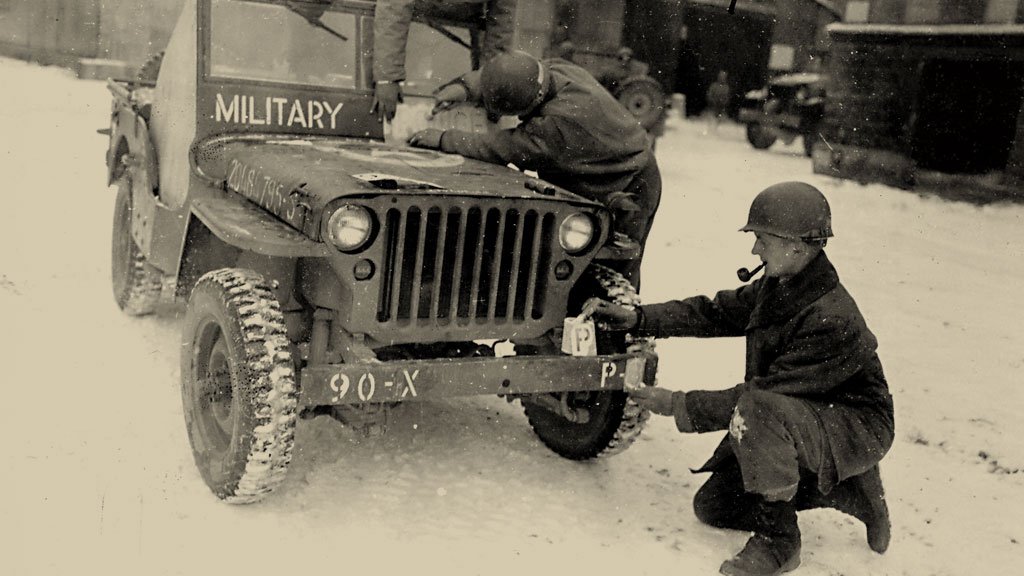
Wartime photo of Ghost Army soldiers

Tour Video


Highlights

Churchill War Rooms

Visit the underground nerve center for Britain’s war effort

Bletchley Park, England

See the intelligence nerve center where the Nazi Enigma machine is housed

Warwickshire, England

Inflate a dummy tank at Walton Hall, where The Ghost Army bivouacked as they trained for their deception mission

Normandy, France

Explore the many D-Day sites, including Pegasus Bridge, Sainte-Mère-Église, Utah Beach, where most of The Ghost Army landed, and Trevieres, where the Ghost Army began their work in France

Avranches and Brittany

Learn how the Ghost Army helped Patton in his breakout that trapped the German 7th Army

Brest

Visit the site of the first Ghost Army deception that used all means of deception, and other sites associated with the little-known Battle of Brest

Luxembourg

Pay homage the the men of the Ghost Army at the site of the only historical marker dedicated to the Ghost Army on the site of one of their most impressive missions

Bastogne

Visit the headquarters of General McAuliffe and the foxholes of Easy Company

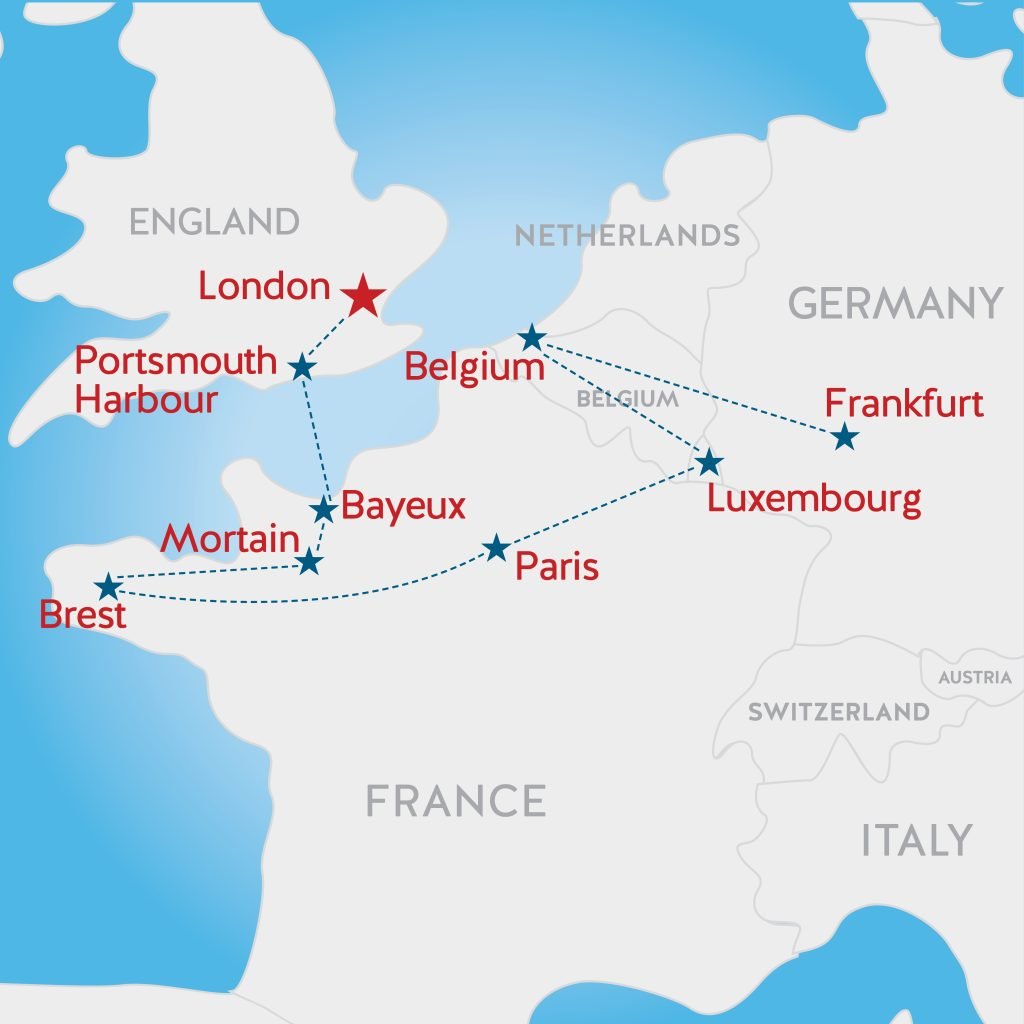
Map of stops on Ghost Army Tour

Itinerary

After arrival at London Heathrow Airport in the morning (for overseas travelers), you will join the group at the designated tour hotel where the group will gather for an evening Welcome Reception followed by dinner. Historian Rick Beyer will treat you to your first lecture, with introductions all around.

The morning features several key sites in London that formed the backdrop for the war effort, including a visit to Winston Churchill’s historic underground bunker: Cabinet War Rooms. You will then depart London for Bletchley Park, nerve center for Allied code breaking. Here you will find the Enigma machine and the complex where Alan Turing and others decrypted Axis codes and cyphers, as depicted in the film The Imitation Game. Tonight you will settle in at Walton Hall, a few miles from Stratford-upon-Avon, where there will be a group dinner.

Walton Hall, a 16th century manor house tucked into unspoiled Warwickshire countryside near Stratford-Upon-Avon, welcomes tour guests just as it did the Ghost Army. The deceivers bivouacked here as they readied for action in spring 1944. You will walk the village and grounds in the morning dew, then test your skills with an inflatable tank and sonic deception on the very spot the GI’s trained. Ghost Army soldiers visited Shakespeare’s Stratford-on-Avon – and you will, too – before heading to Portsmouth, a major embarkation site for the vast D-Day armada.

At Portsmouth, you will tour Southwick House, the advance command post of the Supreme Headquarters Allied Expeditionary Force. The invasion-day map room where SHAEF commander Dwight Eisenhower counted down the final hours before D-Day is beautifully preserved. Here you will learn about his agonizing “go/no-go” decision in the face of terrible weather just before D-Day. The next stop is a visit to the newly refurbished D-Day Museum to examine the launch of the cross-channel invasion.

Then, it’s all aboard the Ferry. You will head across the English Channel to Normandy, and enjoy a fine dinner as the sun sets over the water.

On your first day in Normandy you will visit Pegasus Bridge, the first landing site of the D-Day invasion. Here the British Sixth Airborne led by Major John Howard made a miraculous glider landing to carry out a surprise attack that took this crucial bridge across the Caen Canal.

You will then travel to Ste-Mere-Eglise, one of the villages where the American 82nd Airborne descended on D-Day. 13,000 American paratroopers and nearly 4000 glider troops landed in Normandy in the early morning hours of June 6. You’ll stop to learn about the heroic defense of La Fiere Bridge before moving on to St. Marie Du Mont, where you can still see Renaissance-style steeple the Germans used as an observation post. Next stop: Brécourt Manor where Lt. Dick Winters with members of Easy Company successfully silenced German artillery firing on American troops landing at Utah Beach.

Finally, you will visit Utah Beach itself, where a large portion of The Ghost Army landed a few weeks after D-Day, and the Invasion Museum that affords a thorough interpretation of the events of D-Day.

Your day kicks off by exploring Pointe du Hoc, where U.S. Army Rangers scaled the cliffs in one of D-Day’s most thrilling actions.

Unique to this tour is a stop in the Norman village of Trévières, the first Ghost Army base in Europe. You will step inside the church in the town square that so many artists in the 603rd captured in photos, watercolor or pen-and-ink.

You will then visit Omaha Beach where American GI’s faced the strongest German resistance on D-Day and incurred the greatest losses. Here too, several contingents of Ghost Army soldiers began their European operations. You will see key points to help you comprehend the enormity of this storied battleground. Fittingly, you will then pay your respects at the American Cemetery. Atop the bluff overlooking the beach, a sea of white crosses mark 9,387 American soldiers’ graves.

Your first stop is the mountaintop town of Mortain, where the Germans launched Operation Luttich, a ferocious August 1944 counterattack against the Americans to cut them in two. You’ll stand on Hill 314 where the 2nd Battalion of the 30th Division put up a valiant defense. En route, you will travel through Cerisy Forest, sight of the Ghost Army’s first full-scale deception.

Then you will visit Avranches, where Patton first took operational control of the legendary Third Army and promptly attacked the Germans in three directions…with a little help from the Ghost Army.

From there, it is on to the Pontaubault bridge, which Patton’s VIII Corps crossed on their drive into Brittany – and which Ghost Army soldiers crossed a week later as they carried out Operation BRITTANY to help General Patton entrap the German 7th Army. We drive across Brittany to Brest.

In August, 1944, American troops bottled up German defenders in the port city of Brest. The Ghost Army was brought in to help to inflate the apparent size of the American forces attacking Brest by impersonating the Sixth armored division. This was the first Ghost Army operation that used all forms of deception: visual, sonic and audio. It is also where they witnessed the deadly consequences of an American attack mistakenly launched right where the Ghost Army was attracting German attention.

You will walk the farm fields where Ghost Army soldiers set up their inflatable tanks and stand in the spot where sonic trucks played their show just a quarter of a mile from enemy lines.

Then comes a trip to the fully restored five-story German bunker that was captured singlehandledy by a “fool lieutenant” of the 101st Airborne to 2nd Rangers. There you’ll see what life was like for soldiers on both sides during this battle.

Before you return to the hotel, you will visit the rocky coast on the westernmost part of France to take in the beautiful views.

In the morning you will take the high-speed train to Paris, while your luggage travels by bus. You will have a free afternoon and evening in the City of Lights.

As the bus proceeds east from Paris, you will stop in Reims to visit the Museum of the Surrender, where German generals surrendered to General Eisenhower in May 1945. Here also is the famed cathedral. Many French kings were crowned here, including Charles VII on July 17, 1429, guided by Joan of Arc.

Traversing France, you will visit Verdun, the monumental World War I battleground. During the Battle of the Bulge, The Ghost Army withdrew to this French town and camped in dank World War I fortifications. You’ll see where they were, and tour the battlefield, monuments and cemetery. Then, it’s on to Luxembourg City.

From mid-September until the Battle of the Bulge in December, The Ghost Army was based in Luxembourg City. You will take a morning walking tour of the Grund, the picturesque quarter painted and sketched by many Ghost Army artists. At the site of Operation Bettembourg, you will pause at the first-ever Ghost Army historical marker (dedicated in 2018). From there it is a short ride to Hamm and the American cemetery. You will visit General George Patton’s grave – as well as that of Sgt. George Peddle, a Ghost Army soldier killed in action. A nearby German military cemetery provides a study in contrasts. At The Seminary where Ghost Army soldiers stayed during their time in Luxembourg, you will stand on the very stage where the great Marlene Dietrich performed for them.

We drive to Bastogne, where the 101st Airborne and elements of the 10th Armored held off 15 German divisions for six days in the Battle of the Bulge. You’ll explore General McAuliffe’s HQ where he replied to German surrender demands with one word: “NUTS.” You’ll visit sites around Bastogne where the battle unfolded – including the foxholes occupied by the “Band of Brothers.” At the 101st Airborne Museum in Bastogne, you will experience what the battle was like for both soldier and civilian. You will also learn about a little-known Ghost Army operation designed to help General Patton’s drive on Bastogne.

You will seek out remnants of the Siegfried Line, the German pillboxes and dragon’s teeth that American GI’s fought so hard to take in late 1944.

At last, it’s on to the Germany’s oldest city: Trier. The Ghost Army spent the final days of the war guarding Displaced Persons camps here. Many artist-soldiers captured scenes of the bomb-riddled city. Your visit includes time to shop and explore this Roman ruins – or maybe even Karl Marx’s birthplace! That night over dinner in Wiesbaden, we will say farewell and recap our enriching foray into history.

There will be a morning transfer to Frankfurt airport (FRA) to catch your flight home.

Let us know you’re interested!

Tour Includes

  • Professional American historian traveling with you throughout the tour, lecturing and answering questions
  • Educational road book of maps and historical information
  • 3 or 4-star hotel accommodations
  • Rooms with private bath or shower
  • Hotel taxes and service charges
  • Touring by private first class air-conditioned motor coach with logistical escort
  • Breakfasts daily, 8 Dinners and a Welcome Reception
  • Channel crossing to Normandy via ferry
  • All entrance fees to museums and attractions

Flights

Flights are not included in the cost of the tour.

Flights

Flights are not included in the cost of the tour.

Activity Level

As with all of our tours, we prefer to spend our time on the battlefields. There will be some museum stops, but please be prepared to walk on sandy beaches and cobblestone streets. There is a fair amount of walking.

If you use a wheelchair, please read our Wheelchair Policy.

Customize this Tour

If you would like to customize this itinerary for your alumni travel association, educational organization, high school, family or other private group, please see our private tours page.

Guest Reviews

8 reviews for 'Ghost Army of WWII Tour'

5 Star100%
4 Star0%
3 Star0%
2 Star0%
1 Star0%

September 13, 2023

Ghost Army Tour

Sarah H. says:
4.5

I just returned from my tour with Rick walking in the footsteps of the Ghost Army (GA) I can’t praise it enough.

I loved hearing/seeing stories/journals/artwork by members of the GA shared at locations where they worked and carried out their deception. We visited monuments that Rick advocated for, dedicated to the GA and went off the beaten path which only enriched the experience. Rick’s knowledge and, even better, his desire to share his knowledge is infectious.Thank you, Rick!


February 13, 2020

This tour will exceed your expectations

Dr. Robert Mayer says:
4.5

We were lucky to have Rick Beyer led this tour and bring his passion for history and especially for this unique deception unit of WWII. As an earlier reviewer noted, you will talk about this the rest of your life.
In Luxembourg we attended a special dedication of the first Ghost Army monument in Europe and heard from the mayor of the city, US ambassador, European WWII veterans and a Ghost Army veteran on the uniqueness and effectiveness of this unit. Rick noted that other cities would have dedications and monuments on future tours. It was quite festive and also the next stop, Bastonge, Rick had arranged for a celebration of the GA veteran on tour. Both the Beyers are great storytellers and know their subject!


January 26, 2019

This tour vastly exceeded my high expectations.

Doug McCord says:
5.0

This tour is in a class of its own. Presented by our passionate guides, Rick and Marilyn Beyer, the tour is the story of people in a background of war. Be prepared for both tears and laughter as you personally experience the pain, passion, and experiences of a little known group of American GI’s interacting with the horror of the war. Without question, this tour is second to none!


January 18, 2019

If you can take but one tour in your lifetime, make it this one!

Marty Goldscher says:
5.0

We didn’t only see history, we felt it. That’s what Rick and Marilyn Beyer did for this tour. They did not just show and tell …. they made us feel what happened 75 years ago. That can only be accomplished by those who love what they do. I had originally planned to tour on my own, but was convinced by my travel partner that an organized tour was the route to go. Little did I know that I would get hooked up with the Beyers. Ended up being a great decision. Our tour had it all …. history, education, personality, humor. Take this tour. You will talk about it for the rest of your life.


January 11, 2019

An excellent tour of a fascinating subject

Harry Forsdick says:
5.0

Although I am interested in history and travel to historic places in the USA, I knew and had traveled to more American Revolutionary and Civil War sites than the European World War sites. So, this tour showed me places and addressed topics that I had never experienced before. It was also more diverse in the types of places we went and subjects we heard about: Places in London related to the founding of the Ghost Army, Bletchley Park’s fascinating subject of code breaking, the actual place where the Ghost Army bivouacked while training in Britain during the buildup to D-Day, …

After crossing of the English Channel spent two and a half days traveling around Normandy in the most emotional part of the tour where you will get a thorough experience in the D-Day operations, the basics of the equipment (tanks and guns) used during the war, as well as famous Beaches of the Invasion and cemeteries where the English, Germans and Americans are buried.

In Rick Beyer, you not only have a guide who is knowledgeable in his subject, but is also the author of several fascinating books about the Ghost Army. As a historian, Rick is a natural storyteller and you will not be disappointed in his engaging way to telling you about what you are seeing. Rick’s wife Marilyn provides another point of view using her own dramatic storytelling talents.

The trip to Paris and subsequent day there gives you a small break from the grim reality of war — you have a day to explore Paris and all that it offers. If prior to Paris was action filled invasion, after Paris is where the Ghost Army got down to business of deception. As an amateur artist I particularly enjoyed a walking tour through the Grund in Luxembourg where Rick showed us paintings by members of the Ghost Army at the actual scenes painted.

Finally we toured a number of sites and museums relating to the end of WWII — as well as some famous sites of WWI battles.

In summary, this is an excellent tour that will educate, entertain and expand your interest in the European World War sites, battles and stories. The focus on the Ghost Army gives it a unique perspective and keeps you focused on a central theme while still understanding what else was going on from the D-Day invasion to the end of the war.


December 22, 2014
Kim Seale says:
4.5

Overall, a very good blend of WWII-related things with some local cultural things.


November 25, 2014

Behind the scenes of the war

John Sice says:
4.5

We wanted to see behind the scenes of the war, and had no idea about the Ghost Army. But any day one sees something new, that’s a good day.


November 18, 2014

Hard to improve this tour

Jane Wood says:
5.0

We were rock stars wherever we went. This tour will be hard to improve on.

Write your review

Your name will be published with your review
Your email address will not be published.
We will keep your review for moderation to verify that you have been a traveler for this trip.

Stay Connected

Sign up for our newsletter, visit us on Facebook, Instagram or YouTube.

Sign Up Now