This was my third tour with SA, second with Chris as Historian. Absolutely the best! Chris brought so much information to the table. He wove the story of Prince Charles into the fabric of the United States. Clair was just awesome. My wife joined me on this tour and enjoyed it very much. We cannot recommend it more highly.
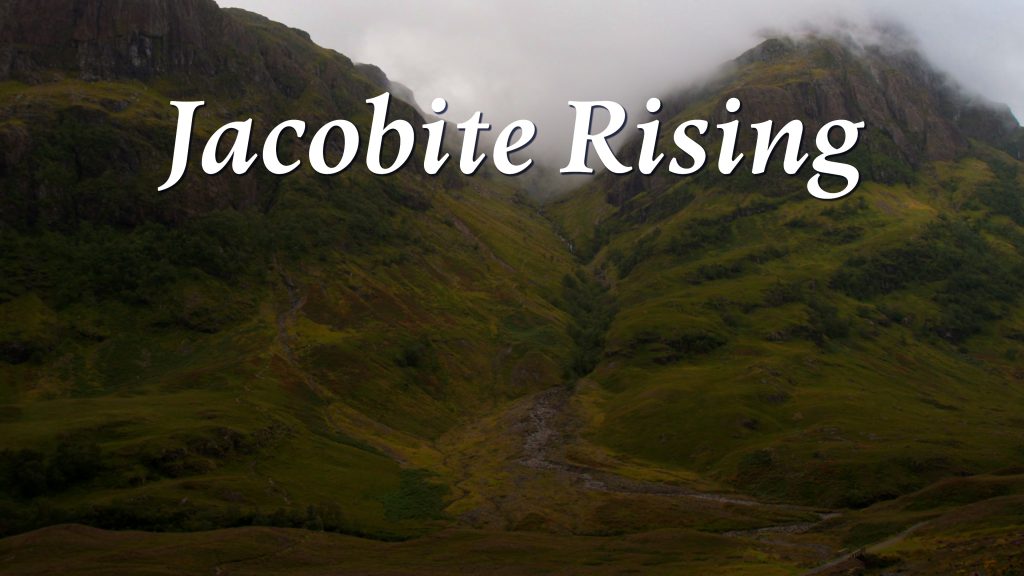
Scotland’s Northern Highlands are a place of mysterious beauty, where Scottish descendants will find a welcoming homeland, and where all travelers will find a unique and inspirational history. As you’ll learn from our Scotland Jacobite Rising Tour, the Highlands have not always been so inviting. In the wake of its defeat by the British army in the Jacobite Rebellion of 1745, Northern Scotland was left with its lands ravaged and its population either annihilated or exiled.
The seeds of the Rebellion were sown in 1603, with England’s first Stuart king, James I, at the time King James VI of Scotland. In 1688 his Catholic grandson, King James II, was deposed and fled to France. Nevertheless, the Stuarts held the throne until 1714, when the House of Hanover assumed the crown.
By 1745, Prince Charles Edward—Bonnie Prince Charlie—was the third generation of Stuarts in exile. Counting on help from France and from Stuart loyalists—the Jacobites—Charles entered Scotland in July of 1745, with the aim of winning back the crown for his father.
Jacobites earned surprising victories at Falkirk and Prestonpans, and, though seriously outnumbered, held off the British at Fort William and other sites. Their luck ran out at Culloden, where they were slaughtered in a savage fight.
Highlights
The National Piping Centre
Enjoy a group dinner and a piping performance at this national and international centre of excellence in Glasgow
Glencoe
See the place where the MacDonalds of Glencoe were slaughtered in a subversive action engineered by the government to look like a conflict between Highland clans, a defining event in Scottish history
Glenfinnan
Visit the site where Prince Charles raised the House of Stuart standard on his arrival in Scotland in September 1745
Highland Folk Life Museum
Get a taste of authentic 18th Century Highland life, walking through a meticulously recreated village and seeing the museum’s collections of artifacts
Edinburg Castle and Holyroodhouse
See where Charles spent extended periods, consulting with his military advisors
The Royal Edinburgh Military Tattoo
Be awed by this annual event, a spectacular showcase for military talent, including pipes and drums, Highland dancers and precision marching formations, with a thrilling fireworks finale
Prestonpans Battlefield
Learn about the first great Jacobite victory
Scotch Distillery
Take a tour and taste Scotch at a famed distillery
Culloden
Study the strategies, accidents and missteps that contributed to this decisive battle between the Jacobites and government forces, the last of the Rebellion
Itinerary
There are more Americans of Scottish descent than there are Scots in Scotland.
In general, the mass migration of Scots began after the tragic events of the 1745 uprising, which saw Prince Charles Edward Stuart, the son of James, the Stuart pretender to the throne of England, lead a desperate expedition to defeat the Hanoverian George II and restore his family to the thrones of both England and Scotland.
Ever since the “’45” reached its bloody climax on Culloden moor, the story of Bonnie Prince Charlie and his army of Highland warriors risking all for a throne has captivated thousands. Famed author Sir Walter Scott set many of his tales of the highlands amidst the characters of the Jacobite uprising and, most recently, the hugely successful television drama Outlander, recalls those dramatic times.
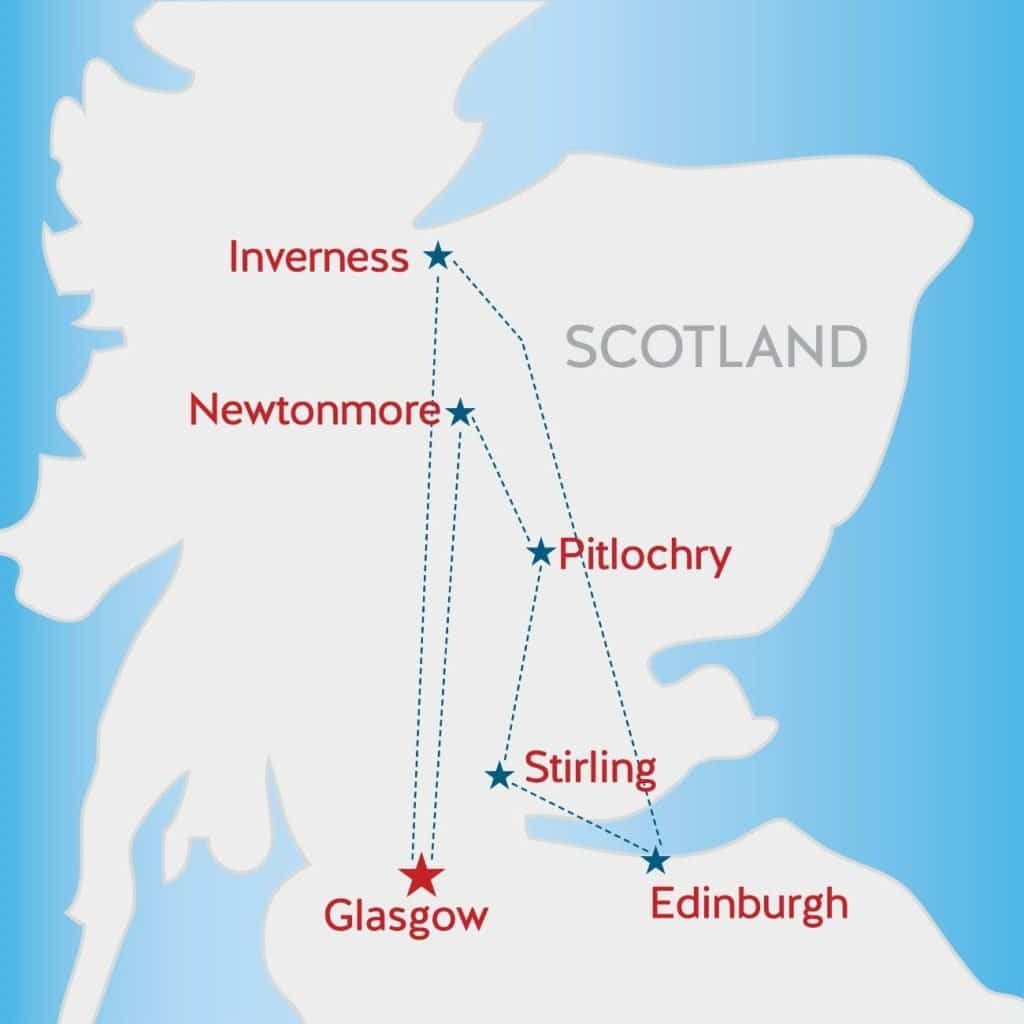
Your tour in the footsteps of the “Bonnie Prince,” will begin in Glasgow, where we will enjoy an opening reception and dinner at the world renown National Piping Centre. You will have a chance to view their unrivaled bagpipe collection before a private dinner and performance and dinner by one of the centers best pipers.
When he first landed in Scotland Prince Charles commanded an “army” of just 8 men. When told by the Scottish chiefs who greeted him to go home, Charles, who had never set foot in Scotland, said, “I am come home.” He then set out on an odyssey that would see him within a few days march of London and his goal-the return of the crown of Scotland, England and Ireland to the house of Stuart.
After breakfast you will travel north from Glasgow through the Loch Lomond & The Trossachs National Park and by Ben Nevis before stopping at Glencoe and the site of the infamous 1692 massacre of the MacDonald’s of Glencoe.
After your visit you will proceed to the Prince’s Cairn and the site of Charles landing on the Scottish mainland and his departure nine months later. Your last stop of the day will be at the imposing Glenfinnan Monument, where Charles raised his banner on August 19, 1745.
After assembling his small army at Glenfinnan, Prince Charles set off into the heart of Scotland with lightning speed. Ironically it was the roads built by British General Wade in the years after the 1715 rebellion that allowed the highland army to accomplish this incredible task. You will leave Fort William to explore some of the dramatic landscape crossed by the Prince and his men as well as learning something of the life of the ordinary highlander of the 18th century.
Your first stop will be at Spean Bridge, where the first fight of the uprising came to an end. While there, you will visit the impressive Commando Memorial, which is dedicated to all of the Allied Special Forces who trained in this rugged landscape during World War II. You will then move on to the renown Highland Folk Museum, as seen in the television series Outlander.
After your visit to the museum and lunch you will travel to Ruthven Barracks. As Charles’ Army marched south, a mere dozen brave British soldiers held the important barracks against the highland army. After the Battle of Culloden, it was to Ruthven that Charles’ battered survivors attempted to rally. Traveling on from Ruthven Barracks you will stop at the historic Pass of Killiekrankie and the site of the dramatic “soldier’s leap.” A central artery of travel in Scotland, in July 1689 the pass of Killiekrankie was the scene of one of the Jacobite’s greatest victories and the source of the highlanders’ fearsome reputation in battle.
Your day will finish up at the imposing Blaire Atholl Castle, the home of the Dukes of Atholl. The castle featured prominently in all of the Jacobite uprisings, but never more so than when Jacobite General Lord George Murray besieged his family home in 1746.
From Pitlochry you will travel to Perth, the first large town in Scotland where Prince Charles proclaimed his father James III, king of the kingdoms of England, Scotland and Ireland. After a short stop at the Mercat Cross you will go to Balhousie Castle, which is the home of the famous Black Watch, the oldest highland regiment in the British Army. You will have a private tour of the state of the art new museum and exhibits about the highlanders who stayed loyal to the crown.
From Perth you will head for Doune Castle, which has played a central role in many of Scotland’s most dramatic episodes. During the Jacobite uprising it was used by the Jacobites to hold British prisoners taken after the Battle of Falkirk, one of whom, made a dramatic escape and after the uprising emigrated to America, where he became the first President of Princeton University and later a signatory to the Declaration of Independence. You may recognize Doune Castle as the site of many of the scenes in Monty Python and the Holy Grail and from the popular television show Outlander.
From Doune you will travel to Stirling, one of the most beautiful cities in Scotland and the location of some of the most dramatic events in Scottish history. Your visit will begin at the famous monument to William Wallace, with its breathtaking views of the surrounding area, including the famous 1297 Battle of Stirling Bridge, before moving on to see the scene of Wallace’s most important victory.
You will spend the morning at Stirling Castle, one of the most historic sites in Scotland. In addition to studying the central role the castle played in the 1745 uprising, you will also have an opportunity to learn about the castle’s long and storied history. Home of Scottish kings and queens for centuries, the castle is one of the finest examples of Renaissance architecture in Scotland and has undergone a major restoration that has restored the royal apartments and Chapel Royal to their original splendor.
After visiting the castle you will make a quick journey to the Bannockburn battlefield where you will learn about Robert the Bruce’s incredible 1314 victory over the English at the new visitor’s center. After learning more about the battles that secured Scottish Independence you will head toward Edinburgh, capital city of Scotland. Along the way we will visit Linlithgow Palace, birthplace of Mary Queen of Scots. You will arrive at your hotel in Edinburgh that evening.
Your visit to Scotland’s capital city will begin along The Royal Mile, which stretches from Edinburgh Castle to the Royal Palace at Holyrood. It was from this stretch of road that a medieval village grew to become the capital city of a great nation. Given its location, the Royal Mile has been at the very center of Scotland’s long and storied history.
You will begin your study of the mile at Edinburgh Castle. Unquestionably one of the most iconic monuments in Scotland, Edinburgh Castle has been fortified since the Bronze Age. Since construction began, the castle has played a part in each of Scotland’s many wars. Among the sites which you will visit at the castle are the crown jewels, otherwise known as the “Honors of Scotland,” which include the famous Stone of Scone; the Great Hall, which was the meeting place of Scotland’s parliament until 1639; St. Margaret’s Chapel, which dates from the 12th Century and is the oldest building within the castle’s walls; the Palace where Mary Queen of Scots gave birth to James VI; and the National War Museum, which traces the history of Scotland’s armed forces from the middle ages to the present day.
From the castle you will follow the Royal Mile down as far as the famous St. Giles’ Cathedral. Officially known as the High Kirk of Edinburgh, it was from here that John Knox directed the Scottish Reformation. In the Kirk you will see the spot where Jenny Geddes, a humble market woman, hurled a stool at a high church preacher as he read from an English prayer book and sparked the Covenanting movement, as well as the Thistle Chapel, home of the Most Ancient and Most Noble Order of the Thistle with its famous bagpiping cherubs. Just outside the chapel you will see Parliament House. Built in 1679, the building served as the home of the Scottish Parliament until the, “Parcel of Rogues,” voted itself out of existence and merged with the British Parliament in Westminster in 1707, an event which had major implications for the Jacobite movement.
This evening we will have a group dinner at the castle before taking our exclusive seats The Royal Edinburgh Military Tattoo.
Today, your first stop will be at the Palace of Holyroodhouse, the official Scottish residence of HM Queen Elizabeth. The palace was built on the site of an abbey by James IV in 1498 and from the time that the first stone was laid it has been at the center of the most important events in Scottish history. You will see the throne and dining rooms that are still used today by the Royal Family, as well as the James V Tower where, on a dark night in 1566, Mary Queen of Scots was holding court when a gang of plotters burst into her quarters and murdered her trusted Italian secretary, David Rizzio, in cold blood. You will also visit the historic state apartments where, in 1745, Bonnie Prince Charlie held court after his victory at Prestonpans before embarking on his desperate invasion of England.
Other stops planned for your second day in Edinburgh will be Greyfriars Church where the National Covenant was signed; the National Museum of Scotland with its renown collection of Jacobite artifacts; and the historic New Town, which is rightly considered a gem of 18th Century architecture and the new Scottish Parliament building.
Leaving Edinburgh you will head to the little village of Tranent, following the path of the Prince’s army as it headed out from Edinburgh to do battle with the British forces under the command of General Sir John Cope.
It would be the first major clash of the uprising. Using a combination of stealth and fury, on the September 17, 1745, 2,300 highlanders charged out of the mist against the 2,500 men of Cope’s army. Terrified by the clansman crashing down upon them, Cope’s army disintegrated in minutes and the Jacobites had secured their first victory crucial victory. In the aftermath of the battle, thousands of Scots enlisted in the Prince’s army and a heretofore reluctant French king decided to more formally back the Jacobite cause. What had begun as a forlorn hope launched in the wilds of Scotland had, overnight, become a very real threat to the security of the Hanoverian Regime in London.
Heartened by their success, the Jacobite high command made the audacious decision to invade England and march on London. Moving with lightning speed, the Jacobite Army seized Manchester on November 29 and by the first week in December were in Derby, just days away from London. On the cusp of victory, the Jacobite high command fell out amongst themselves and the decision was made to return to Scotland where, it was hoped, the army would be greeted with large numbers of new recruits and regular soldiers sent from France. For more than a month the Jacobite Army alluded their pursuers until, on January 17, 1746 they turned to meet their opponent at Falkirk. In what was to be the largest battle of the whole uprising-more than 7,000 men per side-Prince Charle’s forces, led by Lt. Gen. Murray, beat a British force under General Henry Hawley. Fought in driving sleet and rain, Murray’s men hurled back the British and demonstrated that they were every bit as professional a force as their opponents.
After spending time to study the battle, you will depart for a famed Scotch distillery, where you will stop for a “wee dram” at the whiskey. You will have an insider’s tour of the distillery to see how Scotland’s amber liquid is made followed by a tasting of whiskeys from around Scotland.
You will be staying at historic Culloden House, which before the rising was the home of Duncan Forbes of Culloden, a British agent who worked diligently to accustom the Scots to the House of Hanover.
After the start of the uprising, Forbes fled and in April 1746 it was taken over by Charles Edward Stuart and his highland army to await a final, climactic showdown with the advancing British forces under the Duke of Cumberland, King George II’s favorite son. On the morning of April 16, 1746, both armies were assembled on a bleak moor outside Inverness. After enduring a punishing bombardment from the English lines, to the skirl of bagpipes more than 5,000 highlanders charged down upon their opponents with sword, shield, claymore and dirk as they had done for centuries. They crashed into the lines of a well-drilled army armed with modern weapons. For a few desperate moments the fate of Scotland was in the balance as the foes battered one another in a brutal hand-to-hand struggle. Eventually, however, the Prince’s Army began to give way and soon routed from the field. It was the last highland charge.
You will study this historic battlefield-the last battle fought on British soil-as well as spend time in the brand new visitor center to discuss the end of the Jacobite Cause. Following lunch at the visitor center you will travel to Fort George, one of the most well preserved 18th Century fortifications in Europe-to discuss the fate of the highlands in the wake of the last Jacobite uprising.
Having seen off the prince and studied the last great highland charge, the group will leisurely make our way to Glasgow. In the morning you will enjoy a boat ride down the scenic Loch Ness. The beautiful loch, the second largest in Scotland, sits 52 feet above sea level and its waters sink to depths of more than 700 feet. It contains more fresh water than all of the lakes of England and Wales combined and, by legend, is the home of “Nessie,” the famous Loch Ness monster. Your cruise will end at Urquhart Castle, one of the most picturesque ruins in Scotland and a stronghold of Clan Grant until the end of the 17th century, when it was destroyed by highlanders loyal to the House of Orange to prevent its capture by local Jacobite clans.
You will spend this evening in Glasgow, the city that grew to wealth as Scottish merchants made the most of the wealth to be found in the American colonies and from where tens of thousands of Scots began their voyage to the new world.
There will be one morning transfer to Glasgow Airport (GLA) to catch your flight home.
Dates & Prices
Tour Includes
- Professional American historian traveling with you throughout the tour, lecturing and answering questions
- Educational road book full of maps and historical information
- Touring by private first-class, air-conditioned motor coach with tour manager
- 3- and 4-star hotels
- Rooms with private bath or shower
- Hotel taxes and service charges
- Breakfast daily, most dinners, and a Welcome Reception
- All entrance fees to museums and attractions
Flights
Flights are not included in the cost of the tour.
Flights
Flights are not included in the cost of the tour.
Activity Level
There are two occasions where you must consider your mobility and fitness level. Killiecranckie is a steep hike down, then back up; there will be opportunities to rest along the way, but it’s somewhat strenuous depending on your level of mobility and fitness. The hill to get to the Wallace Monument has a similar incline. Once at the monument, there are 246 steps on a spiral staircase to get to the top chamber and enjoy a beautiful view. There is a shuttle to take guests with mobility issues up the hill, but there is very limited space. Please prepare yourself for the hikes.
If you use a wheelchair, please read our Wheelchair Policy.
Recommended Reading
- Fight for a Throne: The Jacobite 45 Reconsidered by Christopher Duffy
- Jacobites: A New History of the ’45 Rebellion by Jacqueline Riding
- 1715: The Great Jacobite Rebellion by Daniel Szechi
- Scotland: The Story of a Nation by Magnus Magnussen
Customize this Tour
If you would like to customize this itinerary for your alumni travel association, educational organization, high school, family or other private group, please see our private tours page.
Guest Reviews
SCOTLAND TOUR
Scotland 2018
This was my first time going on a Stephen Ambrose tour and I must say that this particular tour was absolutely remarkable!!! Historian Chris Anderson was amazing with all of the facts that he gave us. We visited places I never dreamed of seeing and the food….what can I say about that other than it was fantastic. Claire did an awesome job with our hotels and the food and keeping us all together…just like a mom!!! I would definitely take this tour again…well worth the money!!! Thank you Chris and Claire and everyone else involved!!!