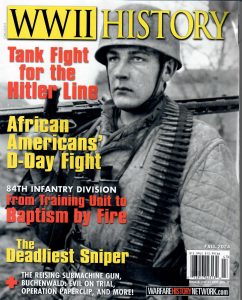
 WWII History has published historian Kevin M. Hymel’s latest article, an interview with World War II veteran and New Orleans local, Bob Wolf, in the Fall 2024 issue. Private First Class Bob Wolf ended the war in Europe fighting with the 86th Infantry Division before heading to the Pacific. Today, he volunteers at The National WWII Museum. Kevin shares his story in “From Bavaria to the Philippines.”
From Bavaria to the Philippines
Private First Class Bob Wolf rode in a jeep along an exposed hill in Germany’s Ruhr Valley when he heard an enemy artillery round screeching toward him. He was out with his battalion operations officer, looking for a place to set up a forward command post. Wolf hit the ground as the shell exploded and fragments tore through the air. A chunk landed next to him and, without thinking, he reached for it before the heat from the smoking hot shard caused him to pull his hand away.
Wolf, an intelligence staffer with the 86th Infantry Division’s 1st Battalion, 343rd Infantry Regiment, wore dog tags around his neck with the letter “H” for “Hebrew.” Dangling with his dog tags was a mezuzah, a small tube with a piece of parchment inscribed with Hebrew verses from the Torah, which further identified his Jewish faith. “In retrospect,” he later reflected, “one wonders how stupid anybody could have been to advertise to the Germans who the Jewish soldiers were.”
By April 1945, the war in Europe was winding down. The great battles of Normandy, the Falaise Pocket, the Netherlands, and the Bulge had all happened the year before. The Rhine River had been crossed in late March. Now the Western Allies were aiming to knock out the German industrial area in the Ruhr, while the Soviets battled for Berlin.
Yet the war was still deadly—German soldiers, looking to draw blood as the Third Reich crumbled, still fought. And the American Army still needed soldiers to fight them. Wolf’s division had been slated for amphibious operations in the Pacific, but there were so many American casualties at the Battle of the Bulge that the Army rerouted them to Europe instead. “We would have been ready for Okinawa,” Wolf said, “but we got turned around.”
Continue reading on Warfare History Network.


