 As anyone who has traveled with Stephen Ambrose Historical Tours knows, our historians are, simply put, the best. They are leaders in their field, world-renowned authors, podcast hosts, documentary filmmakers and sought-after experts for articles, movies and TV shows.
But who are they really? To give you an inkling, we thought it would be fun to modify the Proust Questionnaire for our historians. Popularized by Marcel Proust, the French novelist and essayist, this set of questions is said to reveal a person’s true nature.
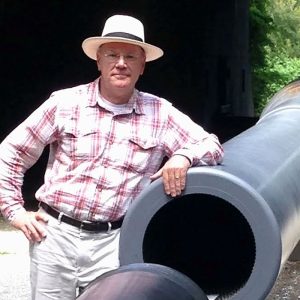
Today, Colonel Pete Underwood, USMC (Ret.), answers our Historians Proust Questionnaire. Pete leads our D-Day to the Rhine and Operation Overlord tours. Pete’s military career included multiple command and staff assignments in the Far East, the United Kingdom, and Germany, as well as participation in Operations Desert Shield, Desert Storm, Desert Fox and Southern Watch. He has taught history at the U.S. Naval Academy (Annapolis, Maryland) and served as Deputy Chairman of the Strategy and Policy Department at the Naval War College. He is currently on the Board of Directors of the Douglas MacArthur Foundation and Museum.
Pete Underwood Answers Our Historians Proust Questionnaire
What is your idea of perfect happiness on tour?
When changes to the daily schedule, which will occur, are explained, and when there are no delays or excessive waiting. In short, when expectations are managed on a daily basis.
What is your greatest fear on tour?
The bus breaking down or getting stuck. This happened to me once when I was a tourist! We spent five hours waiting.
What do you consider the most overrated virtue of a historical figure?
That they seemed to know what was going to happen.
What is the quality you most like in a historical figure?
The ability to make decisions in the face of uncertainty. All commanders have to make difficult decisions, almost always with only a vague knowledge of what is happening and almost always with very little time to decide. In hindsight we think they had better information than they did, and we have little understanding of the pressure they were under to make a decision.
History is full of examples. When a commander made the right decision, we think they were brilliant. When they made the wrong decision, we think them incompetent. Louis XIV’s great commander Marshall de Saxe said that any general that has not lost a battle, has not fought many battles. What is important is that they were able to make a decision and act on it.
Which words or phrases do you most overuse on tour?
“Once again”. I repeat what I think are important points because sometimes not everyone is always listening and so they ask me to explain an issue I have already explained. I think I overdo it!
When and where are you happiest when on tour?
After we have left a historical site and people start asking detailed questions about how and why the decisions were made and why they were implemented as they were.
Which talent of a historical figure would you most like to have?
The ability to impose your will on unfolding events.
If you could change one thing about yourself, what would it be?
Make myself younger!
What do you consider your greatest achievement on tour?
When someone says that I have changed their perspective on an historical event.
If you were to die and come back as a historical figure, who would it be?
Winston Churchill. He was the embodiment of indomitability. He never succumbed to adversity. No matter how bad the situation, he always remained optimistic and refused to surrender.
In which period of history would you most like to live?
If I was wealthy, any period. Otherwise right now is the best time to live. Today, even ordinary people enjoy a quality of life unheard of in any other period of history. We live longer, enjoy better health and with modern transportation are able to travel the world in a manner unimaginable by even our grandparents. When Coolidge was President in the 1920’s, his son got a blister on his foot while playing tennis. It became infected and he died. Today, that is inconceivable. Modern travel on trips like Stephen Ambrose Historical Tours offers was also inconceivable by our grandparents’ generation.
What is your most treasured possession?
My integrity.
What is your most marked characteristic as an historian?
Looking at events from a broad perspective instead of a narrow, focused perspective.
What do you most value in your guests?
A genuine interest in the topic and a willingness to ask questions.
Who are your favorite writers?
Winston Churchill, Douglas Southhall Freeman, Joseph Conrad
Who is your hero of historical fiction?
Captain MacWhirr of the steamship Nan-Shan, from Joseph Conrads story “Typhoon”.
Which historical figure do you most identify with?
Robert E. Lee. Lee has been transformed into a larger-than-life figure, when he was really a very ordinary person. Like most of us, he struggled with money, family and career. While he was successful, he was not overly successful. Then the Civil War forced him to make agonizing decisions most of us cannot imagine. Today it is easy to either think he was morally corrupt for fighting for the Confederacy or noble for siding with his family and State. Fortunately, few of us have to make such difficult decisions.
Whichever side you fall on, his example of doing his duty, as he understood it, despite the repercussions to his name, his career his personal wealth; we need to understand that he did what he believed was his duty. Whenever we have to make difficult decisions, his example of a really ordinary person, choosing duty over personal advancement, is something I believe we should all admire.
Who are your heroes in real life?
George Washington, Robert E. Lee, George C. Marshall, Winston Churchill
What is your motto?
Fear God and Dread Naught


