 The first landings in the Ryukyu Islands came later than planned due to the American invasion of Iwo Jima and the inability to shift shipping fast enough to meet the original timetable. Maj. Gen. Andrew Bruce’s 77th Infantry Division, called the 77th Marines by the Marine Corps for their performance earlier in the War, landed on March 26, 1945, in the Kerama Islands. The quick but brutal fight with the Maj. Gen. Bruce’s division killed 500 Japanese troops. Three hundred suicide boats were discovered, much to the dismay of the U.S. Navy.
The quick operation, which was completed by March 29, allowed Maj. Gen. Bruce to place heavy artillery on the islands to bombard the landing beaches of Okinawa and Lt. Gen. Ushijima’s headquarters at Shuri Castle.
On April 1, 1945, the invasion began on the main island of Okinawa.
Okinawa would be the largest American invasion of the war, with over 500,000 men involved in the operation, including the 5th Fleet and 1,600 Naval vessels.
The Typhoon of Steel
As noted in the book Tennozan: The Battle of Okinawa and the Atomic Bomb, George Feifer in Tennozan records the impression of a young naval officer observing the landings:
“We’ve all seen amphibious landings on the movies…. but the real thing is more spectacular than anything I ever dreamed of. The precision bombing of the beachhead by scores of planes, the monotonous shelling of the shoreline by the huge ‘wagons,’ the wave after wave of LVTs, small boats, etc., heading into the island continued a display so formidable and awe-inspiring, I shall never forget it. It seemed so much like a tremendous dream; one couldn’t feel fear. I’m thankful I had the opportunity to see it all from my grandstand seat in the pilot house.”
While the young American naval officer was impressed and “couldn’t feel fear” ashore, a Japanese officer peered through his binoculars out at the incoming landing and reported: “You can’t make out the color of the ocean because of the enemy ships.” He quickly changed his assessment: “I take that back. It’s 70 percent ships and 30 percent ocean.” A staggering 1,600 ships sat off the coast of Okinawa, with the Tenth U.S. Army poised to begin landing operations.
As the Marines and Soldiers clambered down cargo nets into waiting landing craft, the Naval bombardment group unleashed the heaviest bombardment for an amphibious landing in world history; over 4,500 tons of ordnance fell on a landing beach just a little over four and a half miles in length and three miles deep. This marked the beginning of what the Okinawans call the “Typhoon of Steel.”
The Initial Landings
The initial landings gained ground rapidly, and claimed objectives expected to take days were secured in hours. By the end of April 3, Maj. Gen. Gieger’s III Amphibious Corps had already begun the turn north while Maj. Gen. Hodge’s XXIV Corps had turned south, spreading out on the island. Maj. Gen. Pedro Del Valle’s 1st Marine Division and Maj. Gen. Lemuel Sheperd’s 6th Marine Division had secured the narrowest point on the island by April 5, an objective projected to take until April 16. Because of this Lt. Gen. Buckner told Maj. Gen. Gieger to push his Corps as fast as he could.
Because of the rapid advance of the III Amphibious Corps, Admiral Richmond Turner sent a message to Admiral Nimitz in which he said, “Call me crazy, but I think the Japs have thrown in the towel.” Adm. Nimitz responded with, “Strike everything after crazy.”
The American Advance
Although the III Amphibious Corps had made a rapid advance, the XXIV Corps’ progress to the south had been slowed initially by small units of Japanese troops, which acted as warning posts for Lt. Gen. Ushijima and forecasted the Corps mainline of advance by April 9. They had stumbled into the first defensive line designed by Col. Yahara. The first mainline comprised a series of ridges and hills that ran the island from the east to the west coast. Maj. Gen. Arnold’s 7th Infantry Division was engaged at Skyline Ridge, Oki Hill, Oki Village, and Tanabaru Ridge.
At the same time, Maj. Gen. Bradley’s 96th Infantry Division was engaged at Kakazu West, Kakazu, Nishibaru Ridge, and Tanabaru Ridge. Although they initially believed that the positions in front of them were another series of outposts, they were indeed the main front line. Fighting across this line would force Lt. Gen. Buckner to call in his reserve division and land Maj. Gen. Griner’s 27th Infantry Division to feed them into the line. Cracks began to appear along the line, and on April 23 Lt. Gen. Ushijima ordered the bombardment of the American lines. Under the bombardment, the Japanese defenders withdrew halfway between the old and new defensive lines.
Elements of Japanese divisions had lightly occupied the positions that the first-line defenders took over. Although the delaying zones were not as heavily defended as the main defensive lines, they were well-equipped to slow the American advance. By the time the XXIV Corps fought, it was through this area and they were forced to be reinforced by Maj. Gen. Gieger’s III Amphibious Corps and Maj. Gen. Griner’s 27th Infantry Division, which had been severely bloodied in pushing into a defensive pocket. Because of this, they were moved north for occupation duty and replaced with Maj. Gen. Bruce’s 77th Infantry Division, fresh from seizing Ie Shima in the north.
Lt. Gen. Ushijima’s Army faced five U.S. Divisions across a frontline that reached five miles across the island. Lt. Gen. Buckner’s casualties were quickly climbing as his advance had slowed. Although he had intended to use speed and maneuver in the battle, it had stalled rapidly into a fight more renunciant of the battlefields of Europe during World War One.
By May 5, the Tenth U.S. Army’s frontlines had begun moving forward again before slamming into the second defensive line, the Yonabaru-Shuri line. Although the Tenth had been engaged primarily with Japan’s 62nd Division earlier, now they face the much heavier 24th Division. Maj. Gen. Sheperd’s 6th Marine Division quickly bogged down at a series of hills west of Shuri Castle called the Sugar Loaf complex. This battle for the complex would pin the 6th division in place for six days, inflicting over 2,600 casualties and seeing an additional 1,200 of the division suffer from combat fatigue.
The Fall of Shuri Castle
On the East Coast, the Maj. Gen. Bradley’s 96th Infantry Division had met a vital point: a towering hill called the Conical. The hill was defended by just over 1,000 troops of Col. Hotishi Kanayama’s 89th Regiment of the 24th Division. Fighting for the hill would last from May 10 to May 25. Although not as costly as the assaults at the Sugar Loaf complex, it slowed the envelopment of Lt. Gen. Ushijima’s headquarters at Shuri Castle in the center of the line. Shuri Castle itself fell to a patrol led by Capt. Julian Dusenbury. To his surprise, as he pushed into the ruins, the castle was largely empty. Under the assaults along his flanks, Lt. Gen. Ushijima had his Army withdraw to their final defensive positions in the far south of the Island, the Yasea and Yoza Ridge areas.
The intense fighting of the prior two months had destroyed most of Lt. Gen. Ushijima’s Divisions as a unified fighting force. However, he still had some command-and-control elements to issue orders to withdraw south in good order.
Lt. Gen. Buckner missed the withdrawal from the Shuri Castle area. He believed that the fall of Shuri would be the end of the battle and that the Japanese Army would make its final stand at its headquarters; this confidence caused some intelligence reports to be missed or ignored. It allowed the withdrawing units a few days in which they were able to complete their forced marches to the final defensive positions. Once they arrived, the units became small islands without direction from higher headquarters.
On June 4, Maj. Gen. Sheperd’s 6th Marine Division conducted a rapidly-called-for amphibious invasion of the Oroku peninsula. This would be the last contested amphibious invasion of the war. On the Oroku, the Marines engaged 5,000 men from the Okinawa Naval base force under the command of Rear Admiral Minoru Ota. The peninsula would hold until June 16 and cost the deplenished 6th Marine Division 1,600 casualties while the Japanese Naval Forces were wiped out almost to a man. While the 6th Marine Division fought on the Oroku, Maj. Gen. Del Valle’s division continued to sweep south and locate the retreating Japanese Forces.
Maj. Gen Arnold’s 7th Infantry Division conducted sweeps down the island’s East coast, engaging small pockets of Japanese holdouts. The two other Army divisions pushed through the island’s center, stopping only when encountering the defenders along the two ridgelines at Yasea and Yoza.
Kunishi Ridge: A Surrender, of Sorts
While the Maj. Gen. Hodge’s XXIV Corps was engaged in the east and center of the island, Maj. Gen. Del Valle’s 1st Marine Division had run into stiff resistance at Kunishi Ridge. After several days of fighting and no gains, a white flag came from the ridge. Maj. Hondo, the commanding officer of the defending Japanese, and a small escort approached the Marine lines. Maj. Hondo asked to speak to the commanding officer of the regiment that he faced. He was led to the command post of Col. Edward W. Snedeker of the 7th Marines. Maj. Hondo said the battle was useless, and the war’s end was in sight. He did not want any more of his men to die, and he did not see the point in killing any more Marines. Col. Snedeker asked him if he intended to surrender. Maj. Hondo responded that he was not because if he attempted to, his men would kill him and charge the Marine’s lines, bringing nothing but useless deaths.
Col. Snedeker asked then what Maj. Hondo wanted. Maj. Hondo responded that he wanted to make a deal: his men would stay in their positions on the ridge, and the Marines would remain in their positions surrounding the hill when the war was over; if they brought a copy of the surrender document, then he and his men would lay down their arms and surrender to U.S. forces. Col. Snedeker said he had no authority to approve the deal but would pass it up the chain of command. Col. Snedeker received permission from the Tenth Army to honor the agreement. As such, Col. Clarence R. Wallace’s 8th Marines were landed and pushed to the front lines, replacing the 7th Marines.
The Final Days
Fighting across the island had degenerated into small unit actions as individual companies and platoons fought over small, localized gains. The battle had been fought just as Col. Yahara had advocated one of bloody attrition.
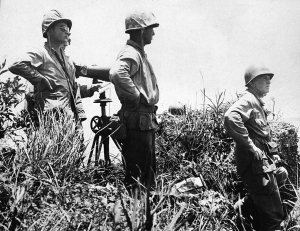
On June 18, Lt. Gen. Buckner arrived at a forward observation post to watch an assault on a reinforced position. As his party climbed to the top of a small hill, a single Japanese gun observed the commotion. Although they did not know who it was, they assumed it was a commander due to all the visible communication gear. The gun crew fired five shots in quick succession. One round struck a rock that Lt. Gen. Buckner had crouched behind, blowing off a piece of coral that struck Lt. Gen. Buckner dead.
Two days later, in their cave, Lt. Gen. Ushijima and Maj. Gen. Cho issued their final orders to the 32nd Army; they were to fight and die in place. The two generals then committed suicide. Organized resistance would continue for another two days before the Tenth U.S. Army turned and began mop-up operations across the island.
After 99 days of fighting on an island that 67 miles long, 18 miles wide, and two miles at its narrowest, approximately 253,000 people were killed; this included over 17,000 U.S. Forces, an estimated 76,000 Imperial troops, and 153,000 Okinawan civilians. These casualties helped lead to the decision to drop the atomic bombs and end the war, as President Truman was quoted as saying, “I do not want another Okinawa from one end of Japan to the next.”


