 By June 1944, the end of the War in Europe was in sight with the Allied landings in Normandy, and attention was slowly turning to the end of the War in the Pacific. The Joint Warfare Plans Committee met in Washington, D.C., to discuss how the persecution of the War would continue in the East. After much discussion, the plans laid out at the SEXTANT Conference in 1943 were abandoned, and instead, a new strategy for the end of the war was implemented.
This new strategy was taken to the end of the double thrust through the Pacific by Admiral Chester Nimitz in the Central Pacific and General Douglas McArthur in the Southwestern Pacific Area. Adm. Nimitz’s thrust would end with the invasion of the Bonin Islands and Iwo Jima, and Gen. McArthur’s would end with the seizure of the Philippines. These two thrusts would meet on the Island of Okinawa in 1945. Okinawa would be used as a jumping-off point for landings in Mainland Japan, which was scheduled for October and December 1945.
The U.S. Commander
Okinawa would be the largest American invasion of the war, with over 500,000 men involved in the operation, including the 5th Fleet and over 1,600 Naval vessels.
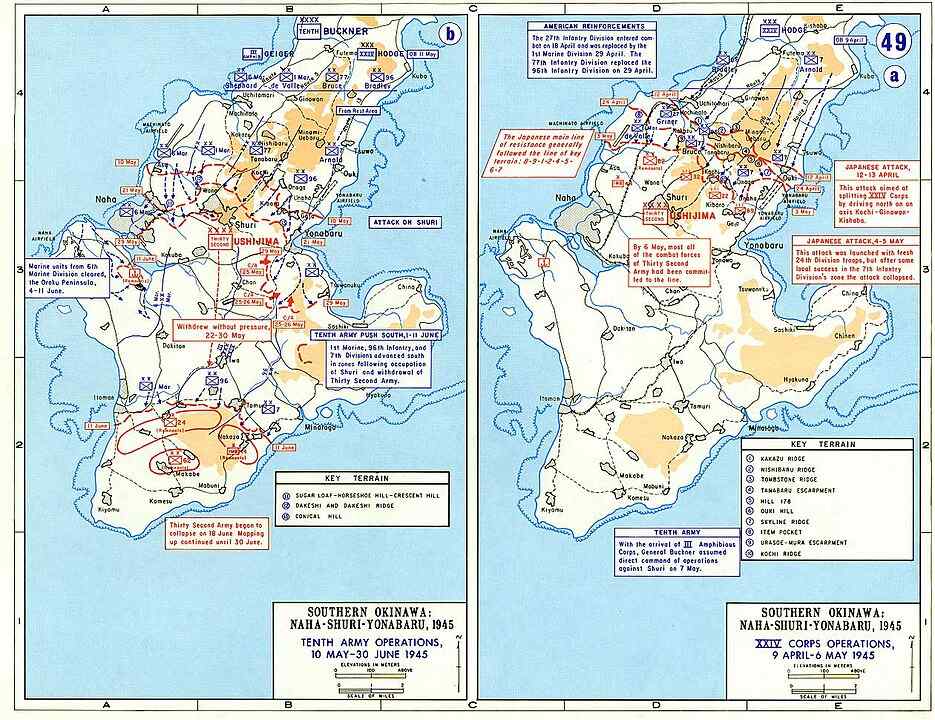
The Tenth U.S. Army, under the command of Lt. Gen. Simon Bolivar Buckner Jr., would conduct the invasion of Okinawa. Lt. Gen. Buckner’s ground forces would include the XXIV U.S. Corps under Maj. Gen. John Hodge USA, with 96th, 77th, and 7th Infantry Divisions and Third Amphibious Corps under Maj. Gen. Roy Gieger USMC with the 1st, 2nd, and 6th Marine Divisions.
Along with his ground forces, he was also assigned additional reserve forces, such as Maj. Gen. George Griner Jr’s 27th Infantry Division as a floating reserve, and the 81st Infantry Division under Maj. Gen. Paul Mueller served as an operational reserve in Saipan. Besides these forces, he also had a tactical Air Force under Maj. Gen. Francis Mulcahy USMC, and an Island Command led by Maj. Gen. Fred C. Wallace USA.
The Japanese Commander
Lt. Gen. Buckner’s opponent would be the thirty-second Imperial Japanese Army under the command of Lt. Gen. Mitsuru Ushijima. Lt. Gen. Ushijima had two key staff members who would dictate how the battle would be fought. The first was Maj. Gen. Isamu Cho, 32nd Army’s Chief of Staff. Maj. Gen. Cho was a firebrand known for his charisma and deep belief in Dai Nippon’s philosophy. The second was Col. Hiromichi Yahara, 32nd Army’s operations officer. Col. Yahara was known by his nickname, “Old Sober sides.” He was quiet, thoughtful, and realistic in his interpretation of conditions throughout the battle, eventually given almost complete tactical control of the Army despite his rank and senior officers.
The 32nd Army that would meet the U.S. forces on landing was a mixture of units and capabilities. The 62nd Division, the Stone Division, was a light infantry division without any combined arms capability or heavy artillery, formed initially to fight guerillas in China. The 24th Division was a heavy division initially assigned along the northern border of Manchuria to fight the Russians, if necessary, as it contained heavy artillery and a mixture of units.
Besides the two divisions, the 32nd Army included the:
- 44th Independent Mixed Brigade, a late-war organization with a mixture of internal unit types and training;
- 27th Independent Tank Regiment, formerly the reconnaissance element of the 2nd Tank Division, mainly comprised of light tanks, tankettes with a smattering of medium tanks;
- 5th Artillery Group which would be the heaviest concentration of artillery the U.S. would face in the Pacific war;
- Okinawa Naval Base Force which was a mixture of service troops and some attached special naval landing forces, and finally;
- Okinawan home guard which were initially organized into labor units before the battle had progressed.
The 32nd Army would be comprised of an estimated 120,000 troops.
Lt. Gen. Buckner’s Plan
Lt. Gen. Buckner’s initial plan was in four main phases. Phase One would be the seizure of the Kerama islands, which are approximately 4 miles from Naha, the prefectural capital. Phase Two would be the landing of the Tenth U.S. Army with two Corps abreast along Higashi Beach. Maj. Gen Hodge’s XXIV Corps would turn south while Maj. Gen. Gieger’s III Amphibious Corps would make its way north to protect the flanks of the XXIV Corps. Phase Three would establish Okinawa as a basing option for 16 divisions to invade mainland Japan. The final phase would seize the smaller surrounding islands in the Ryukyu Chain.
His timeline from landing to Okinawa that could be used to build those bases was 45 days, and the chain was to be secured within 90 days. Although Lt. Gen. Buckner’s plan seems ambitious in hindsight, it was based on the information intelligence that he had received after the October 10 air raid and the follow-up reconnaissance missions. He was informed that the total troop strength of the Japanese was between 50,000-70,000 and a civilian population of 150,000 based on available water sources.
The Japanese Options
Col. Yahara developed four options for Lt. Gen. Ushijima’s consideration. The first option was to meet the American invasion on the landing beaches with mass wave assaults and attempt to throw them back into the sea. Although he had presented this as an option, Col. Yahara also cautioned that this tactic was yet to work on any of the Allied landings, and there was little hope that the assault troops could defeat the heavy firepower that the invasion could bring to bear on the assaulting forces.
Option two would be to spread the 32nd Army’s combat formations from one end of Okinawa to the next and defend every inch of the soil. This was a possibility as, unlike other islands, Okinawa was considered part of the Home Islands of Japan. However, like the first option, this would see the destruction of the Army in a piecemeal fashion as he warned that the American firepower would allow them to concentrate an attacking force on one location, blowing a hole through the line and then utilizing their mobility begin to roll the defensive lines up, destroying the army in what he referred to as a “death of a thousand cuts.”
His third option was to abandon the southern half at the narrowest spot at approximately two miles. This would allow the 32nd Army to create defensive positions in depth in the mountainous region in the North. Col. Yahara once again cautioned and said that the American’s strategic objectives were all located in the south, and this option would most likely find the 32nd Army isolated in the north, where the Americans would let them “die on the vine.”
His final option was to abandon the north of the island and concentrate the Army in the south, going as far as abandoning the airfields that would be able to operate once the American fleet was in the vicinity. In the South, he further stated they would build defensive lines close enough to support each other and use the maneuver they possessed to move between the lines as positions fell, slowing the American advance. The goal, he stated, would not be to defeat the American invasion but instead to draw out the battle as long as possible, keeping the supporting fleet tied to the invasion force while increasing the American casualties in the hope of negotiating favorable surrender terms and no invasion of the Home Islands.
Lt. Gen. Ushijima chose the fourth option, and as such, the 32nd Army began to dig in all over the southern portion of the Okinawa; all the Army could do was wait.


