 As anyone who has traveled with Stephen Ambrose Historical Tours knows, our historians are, simply put, the best. They are leaders in their field, world-renowned authors, podcast hosts, documentary filmmakers and sought-after experts for articles, movies and TV shows.
But who are they really? To give you an inkling, we thought it would be fun to modify the Proust Questionnaire for our historians. Popularized by Marcel Proust, the French novelist and essayist, this set of questions is said to reveal a person’s true nature.
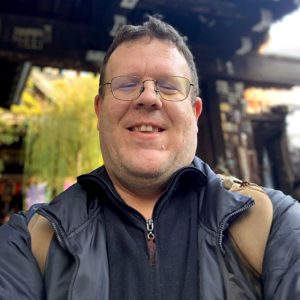
Today, Mark Waycaster answers our Historians Proust Questionnaire. Mark leads our Battle of Okinawa Tour and is one of the historians for our War in the Pacific: Northern Marianas Tour. His primary research focus is on military history and the Battle of Okinawa. He has served as the curator of the Battle of Okinawa Historical Display in Okinawa, Japan, and currently serves as the President of the Board of Directors for the Battle of Okinawa Historical Society. He has given presentations, lectures, and keynote addresses on a wide array of military history topics, including the War in the Pacific, the Battle of Iwo Jima, and the enduring consequences of the Battle of Okinawa.
Mark Waycaster Answers the Historians Proust Questionnaire
What is your idea of perfect happiness on tour?
Perfect happiness is engagement. I love it when I say something on a tour, and then I have follow-up questions. It allows me to expand on ideas and thoughts versus looking at your left kind of tour.
What is your greatest fear on tour?
Site closure. 99.9% of the time, we know if a site is going to be open or closed, which allows for the progression of your storyline, but I have had sites close “just because” and it messes up the points that I wanted to make there.
What do you consider the most overrated virtue of a historical figure?
Applied virtue. We tend to turn and look at our historical heroes out of context for the time and place they lived. We typically attribute skills, knowledge, and forewarning to where there are none.
What is the quality you most like in a historical figure?
Adaptability. We often look at the figures that attack a problem the same way, in the same style, and say they won through their perseverance, but seldom do we look at figures and say, “Well, they were lost from the beginning but figured a different way out.”
Which words or phrases do you most overuse on tour?
“Check this out!” or “Yes, but….” My entire goal is to engage. Guests are there to learn, but if I speak like Charlie Brown’s teacher or look to the left and look to the right, the fundamental points are missed. Stephen Ambrose Historical Tours stands out among other tour companies as we have guests who know much about the subject or portions of it. It is “our” or my responsibility to add to that. My grandmother once told me, “A Day without learning something new is a wasted day.” I try to ensure that our guests never have a wasted day.
When are you happiest when on tour?
When I am engaged. That means that question that I don’t have a quick answer for or that time when everyone seems tied into the story that is being told. When you look out and see that in the faces of the folks you are talking to, there is no better sight in the world.
Which talent of a historical figure would you most like to have?
“Instant Charisma.” Many figures, such as General Douglas MacArthur, had “instant charisma.” When you were in their presence, you instantly felt connected with them. I have what they would call the slow burn. Most of my guests have commented that initially, they thought I was a G.I. Joe speaker, what I call “punch a nazi in the nose.” But they learned I genuinely want them to see a battle, campaign, or war from all sides. If we tend just to watch something from one side, we learn nothing but how feedback sounds. When we analyze an action from every available side, it puts everything into perspective, making it what it was versus a caricature of itself.
If you could change one thing about yourself, what would it be?
One of the things I had brought to my attention on a recent tour was “Mark seemed cocky because he was a Marine….” It is that perception that I would like to change. I tend to speak loudly and emphasize points, but it is like a dear friend said, “You are 6’1” and 200+ lbs., so when you talk, people tend to back off.” So, I hope that guests will come to see that what appears to be cockiness is actually enthusiasm for the history I cover.
What do you consider your greatest achievement on tour?
Several years ago, I did a multi-day tour for the Australian Defense Force Academy in Okinawa. Following the tour, many cadets and ensigns reached out to me for additional information, which many used to write for their senior papers or articles for the Australian Military. I also recently discovered that the format I used for the tour was adopted as their SOP for all their future Staff and academy tours.
If you were to die and come back as a historical figure, who would it be?
This is a tricky question because, in hindsight, we see both those individuals’ qualities and deficiencies. I would like to be able to transverse time and serve as the Hoplite, Centurion, man at arms, rifleman, etc., to see the battles, campaigns, and wars as they transpired versus what is necessarily written about them. Over the years, what I have seen in private diaries, etc., is that what is recorded in history is not always what happened at the tip of the spear.
Which period of history would you most like to live in?
I would live in Japan during the Basakura, warring states period, but I would have to be a minor Samurai family for a Damio lord. The period is fascinating with its different factions and alliances that shift at a moment’s notice.
What is your most treasured possession?
I have a tsuba used at the Battle of Sekigahara. It was carried by one of the foot soldiers of the eastern armies.
What is your most marked characteristic as an historian?
Research!!! That is the one thing I am always called out about. I have hard drives and file boxes of documents about battles and campaigns. Just one of my drives is almost 4.5 TB full of information. I constantly check and recheck information against what is published or given to me; in some cases, the information does not always link up.
What do you most value in your guests?
A questioning mind. When guests question what is given or what they “know,” it is a good day. That means that the individual is engaged in the conversation and that by the end of the day, somebody will have learned something new.
Who are your favorite writers?
I like Ian Toll, Bennis Frank, Edward Drea, John Tolland, Max Hastings, and Dan King for Pacific area information. For the European conflict, it is a completely different list.
Who is your hero of historical fiction?
I always liked Sam Damon in Wings of an Eagle.
Who are your heroes in real life?
The men and women who continuously put their people’s protection before their own.
What is your motto?
Scientia est potential. In knowledge is Power.


